
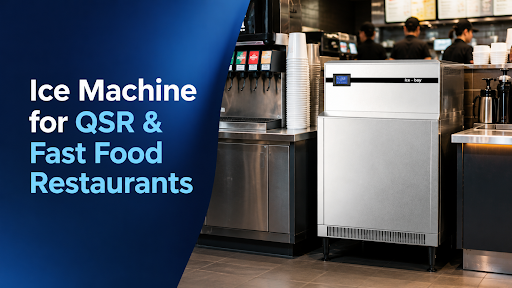
- A quick-service outlet may serve many cold drinks in a short period.
- Start with cold drinks sold on the busiest realistic day, not the monthly average.
- Now look at the shortest, hardest rush.
- Imagine a fast-food outlet expects 180 cold drinks during its busiest hour.
- Ice Boy’s 2026 catalogue says its daily production ratings are measured at 10°C air and 10°C water.
The best ice machine for QSR use is not simply the model with the largest daily output. It must make enough ice for the full day and hold enough ready ice for the busiest hour.
- Measure how much ice goes into one drink.
- Multiply it by cold-drink sales on your busiest realistic day.
- Check how much ice is needed during the busiest hour.
- Compare both daily production and storage capacity.
- Allow for hot air, warm inlet water and other departments using the same ice.
- Decide whether one larger machine or two smaller machines gives your outlet the safer plan.
Ice Boy models worth comparing include the BVM-210 and BUZ-330 for bullet ice, plus the SQ-220 and SQ-275 for dice ice. The right choice depends on your drinks, rush pattern, available space and backup plan.
A QSR usually does not run out of ice slowly. It happens in the middle of a lunch or dinner rush, when the bin empties faster than the drink counter can wait.
Takeaway cups line up, delivery orders keep arriving and staff start sharing ice between stations. A machine that looked large enough on a daily chart can suddenly feel too small.
That is why choosing an ice machine for QSR service needs two separate checks. First, can the machine make enough ice over the whole day? Second, will enough ice be ready when orders arrive together?
This guide explains both checks and compares practical Ice Boy options without assuming unpublished claims.
Why QSR Ice Demand Is Different
A quick-service outlet may serve many cold drinks in a short period. The beverage counter cannot pause for the machine to catch up.
Ice may be needed at several points:
- Soft-drink and soda stations
- Iced tea, lemonade and cold coffee
- Takeaway and delivery cups
- More than one floor or service counter
Ice Boy’s Food and Beverage page gives 80 to 150 kg/day as a typical QSR range and suggests 1 to 1.5 kg of ice for every ten beverage servings. These are Ice Boy starting points, not a fixed rule.
Cup size, fill level and refills change the real number. Measure your drinks before choosing.
Measure Two Numbers Before You Compare Models
1. Ice needed for the full day
Start with cold drinks sold on the busiest realistic day, not the monthly average.
Daily drink ice = cold drinks sold x measured ice per drink
Then add other ice uses and a sensible allowance for unusually busy days. Keep this separate from the effect of hot site conditions.
2. Ice needed during the busiest hour
Now look at the shortest, hardest rush.
Rush ice = cold drinks sold during the busiest hour x measured ice per drink
Compare this number with the ice expected to be ready before the rush. This is where storage capacity matters.
A machine rated at 125 kg/day does not place 125 kg in the bin at one time. It makes ice across the day, while the bin holds only part of that amount.
Worked QSR Rush Example
Imagine a fast-food outlet expects 180 cold drinks during its busiest hour. Staff measure an average of 0.13 kg of ice in each finished drink.
180 x 0.13 kg = 23.4 kg of ice during the rush
Now compare 23.4 kg with the published storage of the four Ice Boy models:
| Ice Boy model | Published storage | Storage left above 23.4 kg on paper |
| BVM-210 | 26 kg | 2.6 kg |
| SQ-220 | 30 kg | 6.6 kg |
| SQ-275 | 30 kg | 6.6 kg |
| BUZ-330 | 60 kg | 36.6 kg |
This does not prove the three smaller-bin models are unsuitable. It shows why the bin test matters. The BVM-210 leaves only 2.6 kg of paper margin. The SQ-220 and SQ-275 leave 6.6 kg. That margin can disappear if the bin is not full, another station uses ice or the rush lasts longer than expected.
The BUZ-330 provides much more spare ready ice in this example. Its 60 kg bin still does not answer every question. The outlet also needs enough daily production, proper installation and a breakdown plan.
Ice Boy does not publish a clear ice-production figure per hour for these models. Ask for this at your room and inlet-water temperatures.
Check Output at Real Site Temperatures
Ice Boy’s 2026 catalogue says its daily production ratings are measured at 10°C air and 10°C water. It also says production at 32°C air and 25°C water is approximately 30% lower.
Using that Ice Boy-published reduction, not an independent test, the rated output would be approximately:
| Model | Published output | Approximate output after a 30% reduction |
| BVM-210 | 95 kg/day | 66.5 kg/day |
| SQ-220 | 100 kg/day | 70 kg/day |
| SQ-275 | 125 kg/day | 87.5 kg/day |
| BUZ-330 | 140 kg/day | 98 kg/day |
Do not simply add 30% to demand. If a machine may deliver 70% of its published rating, compare demand with that reduced output or divide the required output by 0.70.
Ask Ice Boy to confirm site output in writing. Temperature, airflow and maintenance can affect performance.
Bullet Ice or Dice Ice for Fast Food Service?
Both can work in a QSR. The better choice depends on the drink and dispenser setup.
Bullet ice
Bullet ice has a rounded shape with a hollow centre. It can work well for soft drinks, juices, iced tea and everyday cold beverages. The Ice Boy bullet-ice range includes the BVM-210 and BUZ-330.
Dice ice
Dice ice has a more regular cube shape. Ice Boy describes its dice-ice machines as suitable for uses that include quick-service restaurants. The SQ-220 and SQ-275 are the dice options in this comparison.
Test the ice in your cup and dispenser. Check whether staff can scoop it quickly and whether it flows properly.
Ice Boy QSR Models to Compare
| Model | Ice Type | Published Production | Published Storage | Published Power | Published Dimensions |
|---|---|---|---|---|---|
| BVM-210 | Bullet | 95 kg/day | 26 kg | 0.65 kW | H890 x W625 x D705 mm |
| BUZ-330 | Bullet | 140 kg/day | 60 kg | 0.75 kW | H1100 x W730 x D730 mm |
| SQ-220 | Dice | 100 kg/day | 30 kg | 760 W | 650 x 655 x 960 mm |
| SQ-275 | Dice | 125 kg/day | 30 kg | 0.75 kW | H960 x W655 x D660 mm |
BVM-210
Ice Boy lists the BVM-210 for QSRs and high-footfall cafés. Its 95 kg/day output and 26 kg bin may suit measured demand inside that range, but its storage can leave little rush-hour margin.
BUZ-330
The BUZ-330 has the highest published production and largest bin in this group. Its 140 kg/day rating and 60 kg storage make it the strongest single-machine starting point among these four options.
SQ-220
The SQ-220 is published at 100 kg/day with 30 kg storage. Consider it when dice ice suits the drink system and the measured rush fits the available ready ice.
SQ-275
The SQ-275 increases published production to 125 kg/day but keeps 30 kg storage. It may improve full-day supply, but it does not add more stored ice for a rush.
Some product descriptions contain wording copied from combination-machine pages. This article does not treat the BVM-210 or BUZ-330 as built-in crushers. Confirm features on the current technical sheet.
One Larger Machine or Two Smaller Machines?
One larger machine is simpler to install and clean, but one fault can stop all in-house ice production.
Two smaller machines can provide backup and serve separate drink stations. They need more space, connections, cleaning and service work.
Compare both plans:
- Total production under actual site conditions
- Ready ice before the rush
- Distance from bin to each drink station
- Water, drainage, power and airflow needs
- Cleaning time for one unit versus two
- What staff will do if one machine stops
- Local service availability and spare-parts support
Ask for both layouts and quotations. Do not assume that two smaller machines will cost less or provide more usable output.
Plan the Site Before Ordering
Before ordering, confirm:
- Potable inlet water with the correct pressure
- Water treatment based on a test of the actual inlet supply
- A suitable drain route
- Stable electrical supply and the required socket or isolator
- Enough airflow around the machine
- Clear access for cleaning and service
- Safe staff access and working clearance
For the SQ-220, the official page lists 650 x 655 x 960 mm but does not identify the order of height, width and depth. Request the current engineering drawing before planning the final space.
Treat Ice as Food
Ice touches every drink, so water quality and handling matter as much as machine output.
The FSSAI Food Safety and Standards Regulations page provides the licensing and hygiene framework, including Schedule 4. A QSR should use potable water, keep food-contact parts clean and prevent hands, scoops or containers from contaminating stored ice.
A self-cleaning feature can help, but it does not replace the model’s cleaning instructions, safe chemicals, staff training or cleaning records.
Get These Details in Writing Before You Order
Ask Ice Boy or the supplier to include these points in the quotation or technical sheet:
- Expected daily output at your room and inlet-water temperatures
- Expected ice production per hour during the busiest period
- Usable storage and whether the bin can be full before the rush
- Ice shape and compatibility with your cups and dispensers
- Water pressure, filtration, drainage, power and airflow needs
- Exact dimensions and working clearance
- Cleaning steps, approved chemicals and cleaning frequency
- Full machine warranty terms and exclusions
- Local service response process and spare-parts availability
- Backup plan if the machine stops during service
- Installation, first-use testing and staff-training charges
Ice Boy has a service-support request page, but it does not publish a guaranteed response time. If response time matters to the outlet, put it in writing before purchase.
Final Thoughts: Which Ice Machine Should a QSR Choose?
Choose the machine that passes both the full-day test and the busiest-hour test.
The BVM-210 and SQ-220 may suit lower measured demand. The SQ-275 adds daily production but not more bin storage. The BUZ-330 has the largest output and bin among these four, giving it more spare ready ice in the example.
None is automatically right for every outlet. Measure one drink, count a realistic busy day, study the hardest hour and check actual site conditions. Then ask Ice Boy for a model-specific quotation.
That is the safest way to choose an ice machine for QSR service without paying for too little capacity or buying more machine than the outlet can use.
Frequently Asked Questions
How much ice does a QSR need each day?
There is no fixed amount. Multiply cold drinks on the busiest realistic day by measured ice per drink, then add other uses and site-condition effects.
Is bullet ice or dice ice better for fast food drinks?
Both can work. Test the chosen ice in your actual cups, lids and drink dispenser before ordering.
Is daily production enough to size a QSR ice machine?
No. Daily production shows how much ice may be made across the day. Storage shows how much ready ice the machine can hold. A QSR needs both figures because a short rush can empty the bin before new ice is made.
Should a QSR use one large machine or two smaller machines?
One large machine can be simpler and use less space. Two smaller machines may provide backup and support separate drink stations. Compare output, storage, installation, cleaning and the plan for a breakdown.
Which Ice Boy models are useful starting points for a QSR?
The BVM-210 and BUZ-330 are bullet-ice options. The SQ-220 and SQ-275 are dice-ice options. Select only after checking measured demand, peak-hour storage, actual site output and installation needs.
Does self-cleaning replace manual cleaning?
No. Follow the current model manual, use approved cleaning chemicals and train staff to handle ice safely. Ask for the full cleaning plan in writing.