
- Not every hostel or PG needs one.
- A short usage audit gives a better starting point than a resident-count estimate.
- Resident capacity indicates the potential number of users.
- Hostels and PGs also need to decide where ice should be produced.
- For most hostel and PG buying decisions, bullet and dice ice are the most relevant Ice-boy formats to compare.
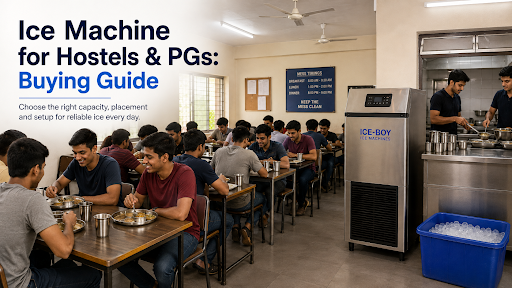
Choosing an ice machine for hostels and PGs starts with understanding where the ice will be used and when demand is highest.
A large hostel does not automatically require a large ice machine. A property with many residents but limited shared ice use may consume less than a smaller PG operating an active mess, beverage station or regular resident events.
That is why bed count should not be the starting point.
The property should first determine its normal daily ice consumption, peak demand, required ice format and the amount that needs to be immediately available during busy periods.
Those figures can then be compared with suitable commercial machines from the Ice-boy product range.
Does Your Hostel or PG Actually Need a Commercial Ice Machine?
Not every hostel or PG needs one.
A commercial machine becomes relevant when ice demand is recurring and large enough that small freezer trays, domestic ice makers or repeated external purchases become inconvenient for the property.
Depending on the facility, ice may be required for:
- mess or canteen beverage service
- chilled-water or beverage stations where ice is actually provided
- common pantry use
- resident events and gatherings
- kitchen requirements where the operation genuinely uses ice
The important point is to measure the demand rather than assume it.
If a small PG uses only occasional quantities, installing commercial equipment may not be justified. A simpler arrangement or purchased ice may remain sufficient.
A larger property with regular daily demand faces a different problem. It needs enough ice at predictable times without repeatedly depending on small batches or last-minute purchases.
The first buying question should therefore be:
How much ice does the property actually use?
Measure Ice Demand Before Looking at Machine Capacity
A short usage audit gives a better starting point than a resident-count estimate.
Record ice consumption for seven representative operating days.
Separate usage according to the areas that actually apply to the property:
- mess or canteen
- beverage station
- common pantry
- resident-access supply
- kitchen
- events or gatherings
If the hostel currently buys ice, note the kilograms received each day rather than simply recording the number of bags.
If ice is already produced internally, measure how much is removed during each major service period.
At the end of the audit, determine three figures.
Normal daily demand: how much ice is used on an ordinary day.
Peak daily demand: the highest consumption recorded on a busy day.
Peak-period demand: how much is required within the busiest few hours.
Peak-period demand is especially important in shared accommodation because ice is unlikely to be consumed at a perfectly even rate.
A property may use most of its daily supply around lunch, dinner or an evening gathering.
Ice-boy’s commercial ice machine capacity guide also emphasises evaluating daily consumption, peak usage and storage when sizing a machine.
Resident Count Alone Can Give the Wrong Machine Size
Resident capacity indicates the potential number of users. .
It does not directly determine kilograms of ice.
Consider two properties.
One may accommodate a large number of residents but serve mainly hot meals with little shared ice demand.
Another may house fewer residents but operate a busy beverage station and hold frequent events.
The second property can potentially consume more ice despite having fewer beds.
This is why a buying guide should not use a rule such as:
“X residents require a Y kg/day machine.”
There is no universal resident-to-ice conversion that can reliably size every hostel or PG.
Instead, consider:
- measured ice consumption
- mess and beverage demand
- event usage
- seasonal changes
- busiest service periods
- the amount of ice required immediately during those periods
The machine capacity should follow those figures.
One Central Ice Machine or Several Smaller Machines?
Hostels and PGs also need to decide where ice should be produced.
A property with one main mess or service area may find that a single centrally located machine is the simplest arrangement.
Central placement can make it easier to manage:
- cleaning responsibility
- water and drainage
- staff supervision
- access to stored ice
- ice transfer
- routine inspection
- maintenance access
In this arrangement, the machine can remain close to the main point of use without being exposed to uncontrolled traffic throughout the property.
A different approach may be considered where a hostel operates multiple buildings or physically separated dining areas.
The property can then compare one higher-capacity central machine with several smaller production points.
Several machines are not automatically better.
They also require additional:
- water connections
- drains
- electrical points
- cleaning schedules
- service requirements
- equipment to monitor
Likewise, one central machine can create unnecessary ice handling if staff must repeatedly carry ice over long distances.
The decision is therefore about capacity and distribution, not capacity alone.
Which Ice Type Works for a Hostel or PG?
For most hostel and PG buying decisions, bullet and dice ice are the most relevant Ice-boy formats to compare.
Bullet Ice
The Ice-boy bullet ice machine range includes multiple commercial capacity levels.
Bullet ice can be evaluated for general beverage and food-service applications where the property prefers this format.
Dice Ice
A hostel or PG that prefers conventional solid cubes can evaluate Ice-boy’s dice machines.
The SQ-65 dice ice machine is a current Ice-boy model with:
- Rated production: 30 kg/day
- Storage: 18 kg
- Rated power: 0.23 kW
The property should choose the format based on its actual use rather than selecting a particular shape simply because it appears more premium.
Ice-boy Machines to Consider for Hostels and PGs
The following models provide several verified capacity steps between 30 and 250 kg/day.
They are presented for comparison. They are not tied to a specific number of hostel beds or residents.
SQ-65
The SQ-65 produces dice-shaped ice.
Current published specification:
- Rated production: 30 kg/day
- Storage: 18 kg
- Rated power: 0.23 kW
It is the lowest-capacity machine included in this guide.
Whether that output is sufficient depends on measured daily and peak ice demand.
BVM-130
The BVM-130 bullet ice machine is currently specified at:
- Rated production: 60 kg/day
- Storage: 25 kg
- Rated power: 0.37 kW
It provides the next capacity step in this shortlist for properties whose calculated requirement exceeds the 30 kg/day level.
That does not mean a particular size of PG automatically requires a BVM-130. The measured ice requirement still determines whether the machine is appropriate.
BVM-210
The BVM-210 is a current model in Ice-boy’s bullet ice machine range.
Its current catalogue specification is:
- Rated production: 95 kg/day
- Storage: 26 kg
- Rated power: 0.38 kW
One specification deserves particular attention: production increases from 60 kg/day on the BVM-130 to 95 kg/day on the BVM-210, but published storage moves only from 25 kg to 26 kg.
For a hostel with concentrated demand, this is exactly why production and storage should be examined separately.
BUZ-330
The BUZ-330 bullet ice machine is currently specified at:
- Rated production: 140 kg/day
- Storage: 60 kg
- Rated power: 0.75 kW
The larger storage capacity provides more immediately available ice than the BVM models covered above.
Whether that additional storage is required should be determined by the property’s peak withdrawal pattern.
BUZ-550
The BUZ-550 bullet ice machine is currently specified at:
- Rated production: 250 kg/day
- Storage: 150 kg
- Rated power: 1.15 kW
This is the highest production level included in this hostel and PG shortlist.
It should be considered only where measured demand justifies that level of ice production and storage.
Ice-boy Options for Hostel and PG Ice Demand
| Ice-boy model | Ice type | Rated production | Storage | Rated power |
| SQ-65 | Dice | 30 kg/day | 18 kg | 0.23 kW |
| BVM-130 | Bullet | 60 kg/day | 25 kg | 0.37 kW |
| BVM-210 | Bullet | 95 kg/day | 26 kg | 0.38 kW |
| BUZ-330 | Bullet | 140 kg/day | 60 kg | 0.75 kW |
| BUZ-550 | Bullet | 250 kg/day | 150 kg | 1.15 kW |
These are current published Ice-boy specifications. The kg/day figure represents rated production and should not be confused with the amount of ice immediately available in the storage bin.
Storage Matters During Mess and Evening Peak Hours
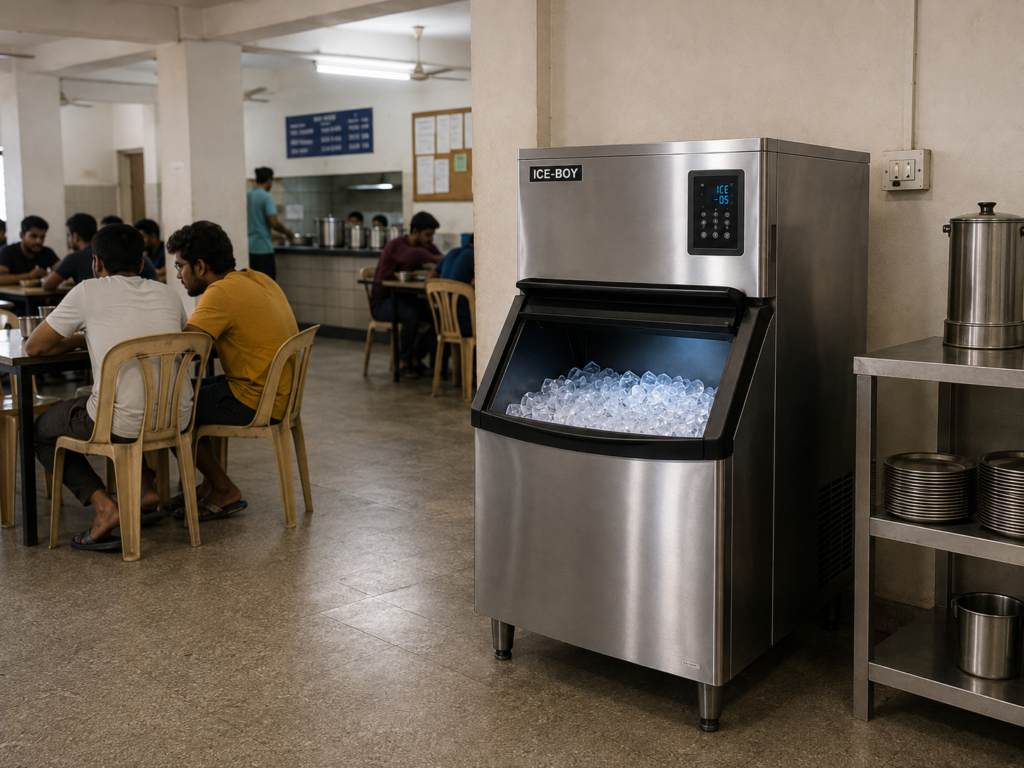
Daily production and storage answer different buying questions.
Production tells the buyer how much ice the machine is rated to manufacture over time.
Storage tells the buyer how much finished ice the machine can hold.
The distinction matters because hostel demand can cluster around scheduled service periods such as:
- lunch
- dinner
- evening beverage use
- weekend gatherings
- resident events
Consider the BVM-210.
It is rated at 95 kg/day, but the current published storage capacity is 26 kg.
That does not mean 95 kg will be waiting in the bin when a busy dinner period begins.
The buyer needs to know:
- how much ice can accumulate before peak demand
- how much will be removed during the peak
- how quickly residents or staff continue withdrawing ice
- whether the machine has enough time to replenish the bin
This is why selecting solely on kg/day can result in a machine that looks adequate on paper but does not match the property’s actual usage pattern.
Where Should an Ice Machine Be Installed in a Hostel or PG?
The machine should be positioned close enough to the main ice-use area to minimise unnecessary handling while still allowing controlled cleaning and maintenance.
For many hostels, this may mean a mess-side utility area, kitchen service zone or staff-controlled beverage point.
Before choosing the location, check:
- water connection
- drainage
- electrical supply
- ventilation
- cleaning access
- service access
- hygienic transfer to the point of use
The temperature around the machine also matters.
Ice-boy’s current technical catalogue states that its listed daily production figures are based on 10°C air and 10°C water.
The catalogue states that production at 32°C air and 25°C water is approximately 30% lower and gives a recommended ambient operating range of 10°C to 38°C.
The 30% figure should not be applied as a universal reduction to every hostel.
It refers specifically to Ice-boy’s stated comparison conditions.
The practical lesson is that a machine installed in a warm mess or kitchen environment may not produce the same quantity as it does under the catalogue’s rating conditions.
Machine location therefore needs to be considered before final capacity is selected.
Shared Access Makes Ice Hygiene More Important
Ice used in beverages or in direct contact with food should be treated as a food-contact product.
FSSAI requirements state that ice used in direct contact with food should be made from potable water and produced, handled and stored so contamination does not occur.
For a hostel or PG, this matters because the ice supply may serve many users.
The operating procedure should address:
- potable incoming water
- routine cleaning of the storage bin
- clean ice scoops
- avoiding direct hand contact with stored ice
- clean transfer containers
- responsibility for cleaning
- separation from waste and dirty utensils
If residents have direct access to stored ice, controlling these practices may require greater supervision.
A staff-managed mess or service point can make responsibility for cleaning and ice handling clearer where the property’s layout allows it.
Buy a Machine or Continue Purchasing Ice?
Not every recurring ice requirement automatically justifies buying equipment.
If the property currently purchases ice, begin with its actual records.
Review:
- kilograms purchased each month
- invoice cost
- delivery frequency
- emergency purchases
- storage needed for delivered ice
- wastage
Then compare those figures with the cost of producing ice on site.
The on-site production assessment should include:
- equipment quotation
- installation
- electricity
- water
- water treatment where required
- cleaning
- maintenance
- service
There is no reliable universal payback period for a hostel or PG.
Electricity tariffs, machine price, water conditions and ice consumption vary between properties.
Likewise, purchased ice should not automatically be described as more expensive.
If demand is occasional, purchasing ice may still be the simpler arrangement.
If demand is regular, measurable and operationally significant, an on-site machine can then be evaluated using the property’s actual costs.
What to Check Before Buying an Ice Machine for a Hostel or PG
Before finalising a model, the buyer should be able to answer these questions:
- How many kilograms of ice are normally used per day?
- What was the highest measured daily requirement?
- How much ice is required during the busiest few hours?
- Which mess, beverage or common-use areas consume it?
- Will production be centralised or distributed?
- Is bullet or dice ice required?
- How much stored ice needs to be available before peak use begins?
- What are the likely air and incoming-water temperatures around the machine?
- Is potable water available?
- Are suitable drainage and electrical connections available?
- Who is responsible for cleaning and ice handling?
- Can technicians access the machine for service?
Ice-boy’s Service Support page provides its current route for machine support and asks for information including the model number, purchase date and warranty status.
The machine should be selected after these requirements are known.
Frequently Asked Questions
How much ice does a hostel need per day?
There is no universal kilogram-per-resident figure.
Measure actual demand from the mess, beverage areas, common-use supply and events. Both total daily demand and peak-period demand should be considered.
Which Ice-boy machine is suitable for a PG?
There is no single model for every PG.
The verified machines covered in this guide range from the SQ-65 at 30 kg/day to the BUZ-550 at 250 kg/day. Their published storage capacities range from 18 kg to 150 kg.
The appropriate model depends on measured consumption, storage needs and installation conditions.
Is one ice machine enough for a large hostel?
It may be where one central mess or service area handles most ice consumption.
Properties with separate buildings or distant dining areas should compare the operational practicality of one central machine with distributed equipment.
Should hostel residents have direct access to the ice bin?
That depends on how the property manages hygiene and supervision.
Where many people share the same ice source, staff-controlled dispensing may make cleaning and handling easier to manage.
Where should an ice machine be installed in a hostel?
Choose a location with suitable water, drainage, electricity, ventilation and service access while keeping the machine reasonably close to its main point of use.
The surrounding temperature should also be considered because Ice-boy’s published production ratings are based on specified air and water conditions.
Does ice used in drinks need to be made from potable water?
Yes. FSSAI states that ice used in direct contact with food should be made from potable water and handled and stored to prevent contamination.
Choose an Ice-boy Machine Around Real Hostel Demand
An ice machine for a hostel or PG should solve a measured operational requirement rather than simply add another appliance to the property.
Record actual consumption first. Identify the busiest demand period, decide where the machine will operate and establish how much ice needs to be available before that period begins.
Those figures can then be compared with Ice-boy’s verified production and storage capacities.
Request an Ice-boy ice machine recommendation for your hostel or PG