
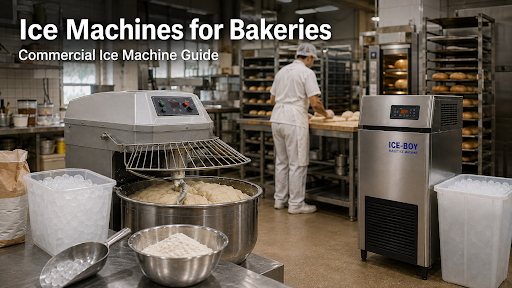
- Choosing an ice machine for bakery production starts with the dough process, not the physical size of the bakery.
- The purpose of ice in dough production is not simply to make the dough colder.
- Not every bakery that controls dough temperature needs an ice machine.
- Mechanical mixing contributes heat to dough.
- Daily dough tonnage is not enough to size the machine.
An ice machine for bakery production becomes relevant when the mixing process requires physical ice to control dough temperature. Mixing generates heat, while flour temperature, room conditions, water temperature and the mixer itself influence the temperature of the dough leaving the mixer.
Not every bakery needs physical ice. Chilled water may be sufficient for some processes. Where measured ice forms part of the bakery’s temperature-control method, Ice-boy offers commercial bullet ice machines from 60 kg/day to 400 kg/day across the models covered in this guide.
Machine selection should be based on ice required per batch, the production schedule, peak withdrawal, storage and actual machine-room conditions.
Introduction
Choosing an ice machine for bakery production starts with the dough process, not the physical size of the bakery.
During mixing, mechanical energy generates heat. At the same time, flour temperature, room temperature, incoming water temperature and the characteristics of the mixer influence final dough temperature. If chilled water alone cannot provide the cooling required by the bakery’s established process, a measured quantity of physical ice may become part of the temperature-control method.
The ice machine therefore has a specific job: producing enough usable ice for the required batches at the time production needs it.
Ice-boy’s bullet ice machine range provides several capacity steps for commercial operations, allowing a bakery to compare machine production and storage against its calculated process ice requirement. Current models in the range include 60, 95, 140, 250 and 400 kg/day options relevant to this guide.
Why Dough Temperature Is the Real Starting Point
The purpose of ice in dough production is not simply to make the dough colder. It is to help the bakery reach the final dough temperature specified for a particular product and process.
The American Society of Baking guidance on mixing explains that mixing generates heat through friction between the product and the mixer. Mixer speed, mixer design, dough quantity and dough temperature can all influence the process.
There is also no single final dough temperature that applies to every bakery product.
ASB lists approximately 25°C to 28°C for lean yeast-leavened doughs. Its reference for laminated pastry is substantially lower at approximately 15°C to 18°C, while non-laminated rich doughs and other bakery products can operate at different temperatures.
This matters when specifying an ice machine.
A bread production line, pastry operation and laminated dough line may all work with flour and water, but their cooling requirements are not identical. The bakery must first establish its required dough temperature and then determine what cooling input is needed to achieve it consistently.
Only after that should machine capacity enter the discussion.
When Does a Bakery Actually Need Physical Ice?
Not every bakery that controls dough temperature needs an ice machine.
If an existing chilled-water system consistently provides water at the temperature required by the process, physical ice may not be necessary. The same applies where other process cooling systems already handle the required thermal load.
Physical ice becomes relevant when the bakery’s established process requires additional cooling or specifically includes measured ice as part of the mixing-water calculation.
That distinction prevents an important specification mistake.
The question is not:
How many kilograms of dough does the bakery make?
The better question is:
How many kilograms of physical ice does the process require, and when must that ice be available?
Two bakeries producing similar dough volumes can have very different ice requirements. One may operate comfortably with chilled water. Another may face warmer flour, higher room temperatures, more intensive mixing or a production formula that requires physical ice.
The ice-machine specification should therefore follow the process rather than determine it.
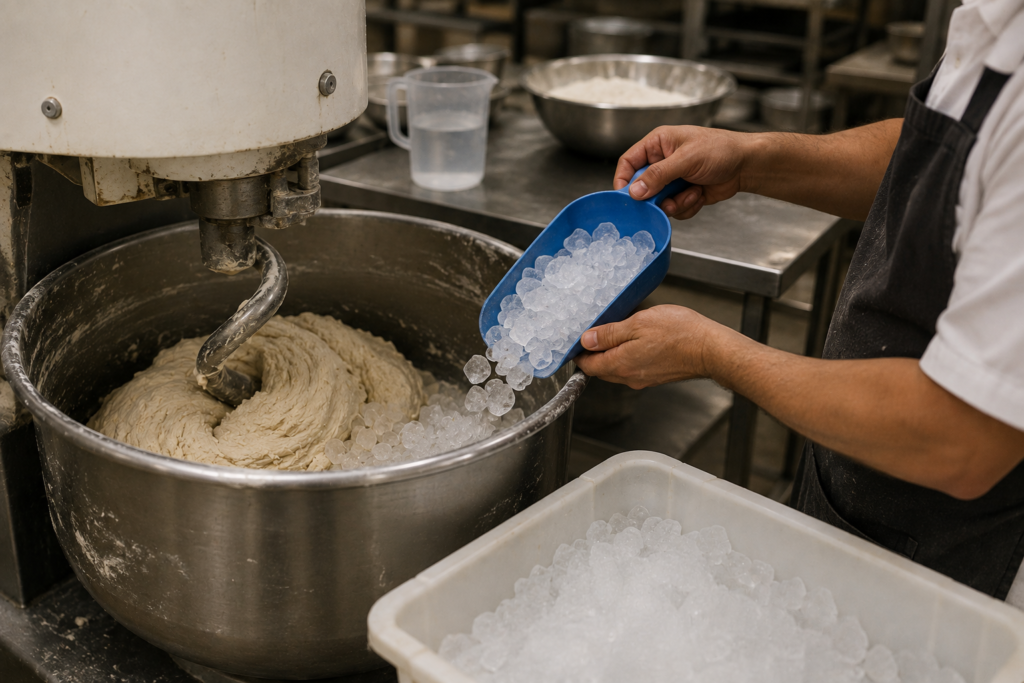
Mixer Friction Can Change the Cooling Requirement
Mechanical mixing contributes heat to dough.
ASB identifies mixer speed, mixer design, dough size relative to mixer capacity and dough temperature among the factors that affect mixing. It also notes that friction between the dough and mixer wall produces heat during dough processing.
This means two bakeries using the same amount of flour do not automatically require the same amount of cooling.
The requirement can change with:
- flour temperature
- bakery room temperature
- incoming water temperature
- mixer design
- mixer speed
- batch size
- mixing duration
- dough formulation
- production sequence
This is why the article should not use a statement such as:
“Use 1 kg of ice for every X kg of dough.”
There is no reliable universal bakery ratio.
The correct quantity needs to come from the bakery’s recipe, target dough temperature and actual mixing conditions.
Once that quantity has been established through production practice or process calculations, it becomes a useful input for selecting the ice machine.
Calculate Ice Demand From the Bakery’s Batch Schedule
Daily dough tonnage is not enough to size the machine.
Start with the amount of physical ice required for one batch.
Then calculate:
Daily ice requirement = ice required per batch × number of batches using ice
For example, if the bakery has already established that a particular recipe requires a measured quantity of ice in every batch, that quantity should be multiplied by the number of corresponding batches scheduled for the day.
The next calculation is even more important:
How much ice is required during the busiest mixing window?
A bakery may use 100 kg of ice across an entire production day but require a large portion of it during the first few hours of morning production.
That means three numbers need to be known:
- Ice required per batch
- Total ice required per production day
- Ice required during the peak mixing period
These figures can then be compared with rated production and bin capacity.
Ice-boy’s commercial ice machine capacity guide provides additional guidance on evaluating daily demand, peak usage and storage when selecting machine capacity.
What Form of Ice Does the Bakery Process Require?
Ice format should be determined before the machine is selected.
The Ice-boy machines covered in this guide manufacture bullet ice. Whether that format can be used directly depends on the bakery’s own mixing process and recipe requirements.
A bakery should not assume that bullet ice, crushed ice and flake ice are technically identical simply because all three provide cooling.
Where the bakery’s established process accepts bullet ice, an Ice-boy bullet machine can provide the required supply.
Where smaller pieces are required, a separate crushing stage may be considered if crushed ice is suitable for the process.
Ice-boy’s ice crusher and slicer range includes the C-103, which takes existing cube ice and processes it into irregular crushed fragments. The crusher does not manufacture ice itself.
The correct sequence is therefore:
target dough temperature → cooling requirement → kilograms of ice → required ice form → machine capacity
This avoids selecting equipment before the bakery understands the process it needs to support.
Ice-boy Machines to Evaluate for Bakery Ice Production
A bakery does not need to compare every Ice-boy model.
For calculated physical ice requirements between 60 and 400 kg/day, the current bullet range provides five useful capacity steps.
BVM-130
The BVM-130 bullet ice machine is currently specified at:
- Rated production: 60 kg/day
- Storage: 25 kg
- Rated power: 0.37 kW
These figures are stated on Ice-boy’s current product page.
It represents the lowest production level covered in this guide. Whether it provides enough capacity depends entirely on the bakery’s measured batch and daily ice requirement.
BVM-210
The BVM-210 is the next production step at:
- Rated production: 95 kg/day
- Storage: 26 kg
- Rated power: 0.38 kW
Ice-boy’s current product range lists the BVM-210 at 95 kg/day, while its technical catalogue confirms the storage and power values.
The relatively small difference between its daily output and the BVM-130 does not remove the need to examine storage and peak withdrawal separately.
BUZ-330
The BUZ-330 bullet ice machine is currently specified at:
- Rated production: 140 kg/day
- Storage: 60 kg
- Rated power: 0.75 kW
The current specification is 140 kg/day. That is the figure to use for current machine comparison.
BUZ-550
The BUZ-550 bullet ice machine provides:
- Rated production: 250 kg/day
- Storage: 150 kg
- Rated power: 1.15 kW
The larger bin becomes particularly relevant where multiple dough batches require substantial ice within a concentrated production period.
BUZ-900
The BUZ-900 bullet ice machine provides the highest output included in this bakery shortlist:
- Rated production: 400 kg/day
- Storage: 220 kg
- Rated power: 2.20 kW
The current Ice-boy range confirms the 400 kg/day model, while the latest technical specifications support the corresponding storage and power figures.
A bakery should not select the BUZ-900 simply because it has the largest number in the table. It becomes relevant only when the process calculation supports that level of ice production.
Ice-boy Ice Production Options for Bakery Operations
| Ice-boy model | Rated production | Storage | Rated power | How to evaluate it |
| BVM-130 | 60 kg/day | 25 kg | 0.37 kW | Compare with measured batch and daily ice demand |
| BVM-210 | 95 kg/day | 26 kg | 0.38 kW | Next capacity step where calculated demand is higher |
| BUZ-330 | 140 kg/day | 60 kg | 0.75 kW | Higher production with greater stored ice |
| BUZ-550 | 250 kg/day | 150 kg | 1.15 kW | Larger commercial process ice requirement |
| BUZ-900 | 400 kg/day | 220 kg | 2.20 kW | High-volume manufactured ice production |
The table uses current Ice-boy specifications. The kg/day values are rated production figures and should not be interpreted as guaranteed output under every installation condition.
Early Morning Mixing Makes Storage Important
A bakery often does not consume process ice evenly over 24 hours.
Several dough batches may be mixed consecutively before the first major baking cycle. In that situation, the quantity of ice already available becomes just as important as daily production.
Compare the current Ice-boy specifications:
- BVM-130: 60 kg/day production and 25 kg storage
- BVM-210: 95 kg/day and 26 kg storage
- BUZ-330: 140 kg/day and 60 kg storage
- BUZ-550: 250 kg/day and 150 kg storage
- BUZ-900: 400 kg/day and 220 kg storage
A machine rated at 95 kg/day does not mean 95 kg will be sitting in the bin when the first mixer starts.
The bakery needs to understand how much ice can accumulate before production, how much the first group of batches will withdraw, and whether the machine has enough time to replenish the bin before the next high-demand period.
This makes peak ice availability a more useful procurement figure than daily output alone.
A Warm Bakery Can Reduce Available Ice Output
The machine’s installation environment matters.
Ice-boy’s current technical catalogue states that published daily production is based on 10°C air and 10°C water.
The same technical information states that production at 32°C air and 25°C water is approximately 30% lower, and gives a recommended ambient operating range of 10°C to 38°C for the listed machines.
That comparison is particularly relevant in bakery facilities containing ovens, proofers and other heat-generating equipment.
It does not mean every bakery will experience exactly 30% lower production.
The figure applies to the specific air and water temperatures stated by Ice-boy.
Before selecting capacity, check the likely temperature at the actual machine location and the temperature of the incoming water supply.
A machine selected with little production margin may not provide the expected amount of ice if site conditions are substantially warmer than the published rating conditions.
Food-Safe Process Ice Starts With the Water
If ice is incorporated into a dough formulation or otherwise comes into direct contact with food, the water supply and ice-handling process need appropriate hygiene controls.
FSSAI bakery training guidance addresses potable water as part of bakery food handling and processing controls.
For a bakery using manufactured ice, practical controls should include:
- potable incoming water
- a clean ice storage bin
- dedicated ice-transfer containers or scoops
- hygienic transfer to the mixer
- routine cleaning of ice-contact surfaces
- appropriate drainage around the machine
The ice machine itself does not make the complete bakery process compliant.
Water quality, cleaning, storage and staff handling remain part of the bakery’s wider food-safety system.
How to Specify an Ice Machine for a Bakery
The final equipment specification should follow the dough process.
Start by confirming the required final dough temperature for the bakery products where temperature control is important.
Then review the temperature of the flour, room and incoming water, together with the heat generated by the actual mixer and mixing cycle.
Determine whether chilled water alone can achieve the required result.
If physical ice is required:
- Calculate the kilograms required per batch.
- Multiply that by the number of daily batches.
- Calculate the requirement during the busiest mixing window.
- Compare machine production and storage separately.
- Check expected output at the site’s air and water temperatures.
- Confirm the required ice form.
- Review water supply, electrical load and drainage.
- Confirm machine footprint and ventilation requirements.
- Define how the ice will be transferred hygienically.
- Confirm technical support for the installation location.
- Compare the complete commercial quotation.
Ice-boy’s Service Support page provides its current technical support request process, including model number, purchase date, warranty status and supporting video submission.
Ice-boy also provides a separate warranty registration process for machine owners.
The model should be selected only after these requirements are known.
Frequently Asked Questions
Why is ice used in commercial bread production?
Mechanical mixing generates heat. Where a bakery’s chilled-water or other cooling system cannot achieve the required mixing conditions by itself, measured physical ice may form part of the temperature-control process.
The required amount depends on the formula, ingredients, mixer and production conditions rather than a universal bakery ratio.
What temperature should the dough be after mixing?
There is no single final dough temperature for all bakery products.
The American Society of Baking lists approximately 25°C to 28°C for lean yeast-leavened doughs, while laminated pastry is listed around 15°C to 18°C. The bakery’s own formulation and process should determine the actual target.
How much ice does a bakery need?
Determine how many kilograms of physical ice are required in one production batch, then multiply that requirement across the batches that use ice.
Peak timing also matters. If several batches are mixed within a short period, the required ice may need to be stored before production begins rather than generated gradually throughout the day.
Can an Ice-boy bullet ice machine be used for dough cooling?
It can be evaluated where the bakery’s established process accepts bullet or cube-form ice.
If the recipe requires smaller particles, a crushing stage may be considered where crushed ice is suitable for that process. Bullet ice, crushed ice and flake ice should not be treated as identical formats.
Which Ice-boy capacity should a bakery choose?
The models covered in this guide provide rated outputs of 60, 95, 140, 250 and 400 kg/day.
The correct choice depends on the calculated physical ice requirement per batch, total daily demand, peak mixing schedule, storage requirement and actual air and water conditions at the machine location.
Size an Ice-boy Machine for Your Bakery Process
If manufactured ice is part of your bakery’s dough-temperature control process, start with the kilograms required per batch, number of daily mixing cycles and the amount of ice required during the busiest production window.
Add the expected installation conditions, storage requirement and available space. Those figures can then be compared with the production and storage specifications of the relevant Ice-boy machines.