
- Commercial ice production should correspond to a defined operational requirement.
- Recovery-related ice and beverage ice should be assessed separately before establishing total machine capacity.
- A commercial ice machine and a cold-plunge chiller perform different functions.
- There is no reliable universal kilogram-per-session figure for spas and wellness centers.
- Total visitor numbers provide limited information about physical-ice demand.
Ice requirements in spas and wellness centers depend on the services that actually consume physical ice. Demand may come from established recovery processes, cold-plunge operations that intentionally use ice, guest beverage service, or a combination of these applications.
Machine sizing should separate recovery-related and beverage demand, measure actual consumption, identify peak appointment periods and compare those figures with production and storage capacity.
The Ice-boy models evaluated in this guide include both dice and bullet ice machines, with verified production capacities from 30 kg/day to 140 kg/day. The appropriate machine depends on the required ice format, measured consumption, peak storage requirement and installation conditions rather than a general preference for one ice shape.
Where Does a Spa or Wellness Center Actually Use Ice?
Commercial ice production should correspond to a defined operational requirement.
A conventional spa focused mainly on massage and relaxation may require only limited ice for guest refreshments. A recovery-oriented facility that incorporates physical ice into an established cold-plunge or session protocol can create a substantially higher demand.
Relevant applications may include:
- cold-plunge operations where physical ice is deliberately added
- recovery services with an established ice requirement
- treatment-room procedures where ice forms part of the facility’s operating protocol
- guest beverage and hydration service
- scheduled group recovery sessions
These uses create different demand patterns.
Beverage ice may be withdrawn gradually across operating hours, while recovery ice may need to be available in larger quantities before a scheduled block of sessions.
Selection from the Ice-boy commercial ice machine range should therefore be based on measured consumption and timing rather than guest footfall, treatment-room count or facility size.
First Separate Treatment Ice From Beverage Ice
Recovery-related ice and beverage ice should be assessed separately before establishing total machine capacity.
Beverage demand is linked to the refreshments served. Recovery demand depends on the facility’s actual operating process and the number of sessions requiring physical ice.
The initial assessment should record:
- physical ice consumed by recovery or treatment services
- beverage ice consumed during the operating day
- peak timing for each application
- quantity required before a service period begins
- replenishment required during operation
The figures can then be combined to determine total production demand without losing visibility of short-period peaks.
Separation is also useful for handling control. Beverage ice enters a food-handling workflow, whereas ice transferred to a recovery area follows a different operational route. Dedicated scoops, containers and transfer procedures provide clearer control where one machine supports both applications.
Does the Spa Need an Ice Machine or a Cold-Plunge Chiller?
A commercial ice machine and a cold-plunge chiller perform different functions.
An ice machine manufactures physical ice and stores the finished product. A plunge chiller removes heat from circulating water and controls the water temperature according to the design of the plunge system.
The presence of cold-plunge services therefore does not automatically create a requirement for an ice machine.
A facility operating a purpose-built chilled plunge may have little need to add physical ice. Where the established operating process intentionally uses physical ice, production and storage capacity become relevant.
An ice machine also does not replace systems responsible for water circulation, filtration, sanitation or plunge temperature control.
The specification should therefore identify whether physical ice is an actual consumable within the wellness operation before machine capacity is considered.
Measure Physical Ice by Session, Then by Day
There is no reliable universal kilogram-per-session figure for spas and wellness centers.
Physical ice consumption can vary according to the application, process design, starting conditions and the quantity established by the facility for each service.
Actual operating data provides a more suitable basis for sizing.
For each service that uses physical ice, record the quantity consumed across a representative series of sessions.
Daily recovery-related demand can then be calculated as:
Measured ice used per session × number of ice-consuming sessions
Beverage demand should be measured separately before being added to total production demand.
Three figures are particularly useful:
- Normal daily demand – expected consumption on a representative day.
- Maximum daily demand – the highest realistic requirement during busy operation.
- Peak-period demand – the amount required during the busiest appointment or service block.
Peak-period demand is especially important because sufficient daily production does not guarantee that enough finished ice will be available at the required time.
Peak Recovery Sessions Can Matter More Than Daily Footfall
Total visitor numbers provide limited information about physical-ice demand.
A wellness center may receive high general footfall while only a small proportion of guests use ice-dependent services. Another facility may serve fewer visitors but schedule several recovery sessions consecutively.
Appointment concentration therefore has a direct effect on storage requirements.
Where sessions run back to back, the storage bin provides the initial reserve. Machine production then replenishes that reserve during the operating day.
For commercial sizing, the facility should establish:
- quantity required before the first high-demand session
- withdrawal during the appointment block
- time available between sessions
- replenishment available before the next peak
This relationship between stored ice and production is more useful than sizing from guest count alone.
What Ice Format Does the Wellness Process Require?
A spa or wellness center should select ice format according to the intended application rather than treating bullet ice as the default option.
Ice-boy manufactures both dice and bullet ice machines. Either format can be suitable for a wellness facility where it meets the operational requirement.
For guest beverage service, dice ice provides a conventional solid cube format and can be produced using Ice-boy’s dice shape ice machine range.
For recovery or other non-beverage applications involving physical ice, the required format should be established by the facility’s operating procedure. Whole dice or bullet ice may be suitable depending on how the ice is transferred and used. Neither format should be presented as universally superior for wellness applications.
Ice-boy’s bullet ice machine range provides another set of commercial production capacities where bullet-shaped ice is appropriate.
Where smaller ice fragments are specifically required, a separate crushing stage may be considered. Ice-boy’s ice crusher and slicer machines process ice that has already been manufactured; they do not replace the ice-producing machine.
The equipment specification should therefore follow this sequence:
application requirement → required ice quantity → suitable ice format → production capacity → storage capacity
This approach allows the facility to compare dice and bullet machines on operational suitability rather than selecting an ice shape before the application has been defined.
Ice-boy Machines to Evaluate for Spa and Wellness Operations
A wellness facility may require dice ice, bullet ice or a combination of requirements that can be served by either format. The shortlist should therefore include representative machines from both Ice-boy ranges rather than assuming that one shape is appropriate for every application.
The following models provide verified rated production steps from 30 kg/day to 140 kg/day.
SQ-65
The SQ-65 dice ice machine is currently specified at:
- Rated production: 30 kg/day
- Storage: 18 kg
- Rated power: 0.23 kW
It provides the lowest production level in this shortlist and can be evaluated where measured demand is comparatively limited and dice-shaped ice is the preferred format. The current Ice-boy catalogue confirms these specifications.
SQ-120
The SQ-120 dice ice machine is currently specified at:
- Rated production: 55 kg/day
- Storage: 18 kg
- Rated power: 0.26 kW
The SQ-120 increases production while retaining the same 18 kg published storage capacity as the SQ-65. For facilities with concentrated demand, that distinction makes storage availability an important part of the comparison. Its live technical specification and current Ice-boy catalogue both state 55 kg/day.
BVM-130
The BVM-130 bullet ice machine is currently specified at:
- Rated production: 60 kg/day
- Storage: 25 kg
- Rated power: 0.37 kW
The BVM-130 represents a comparable production level in bullet format, with greater published storage than the two dice models above.
BVM-210
The BVM-210 is part of Ice-boy’s bullet ice machine range and is currently specified at:
- Rated production: 95 kg/day
- Storage: 26 kg
- Rated power: 0.38 kW
It provides a higher daily production step while retaining a relatively compact 26 kg storage capacity. This makes it more relevant where the requirement is sustained production across the operating day rather than a particularly large ready-ice reserve. Ice-boy’s current catalogue confirms these figures.
BUZ-330
The BUZ-330 bullet ice machine is currently specified at:
- Rated production: 140 kg/day
- Storage: 60 kg
- Rated power: 0.75 kW
Its higher production and larger storage capacity provide another option where measured ice consumption and concentrated session demand justify a larger commercial machine.
Ice-boy Options for Spa and Wellness Ice Demand
| Ice-boy model | Ice type | Rated production | Storage | Rated power |
| BVM-130 | Bullet | 60 kg/day | 25 kg | 0.37 kW |
| BVM-210 | Bullet | 95 kg/day | 26 kg | 0.38 kW |
| BUZ-330 | Bullet | 140 kg/day | 60 kg | 0.75 kW |
| BUZ-550 | Bullet | 250 kg/day | 150 kg | 1.15 kW |
These are current published Ice-boy specifications. The models provide representative capacity steps across dice and bullet formats; they are not recommendations based on a fixed number of guests or treatment rooms.
Rated production describes the amount of ice the machine is specified to manufacture under stated operating conditions. Storage indicates the quantity of finished ice the machine can hold and should therefore be evaluated separately.
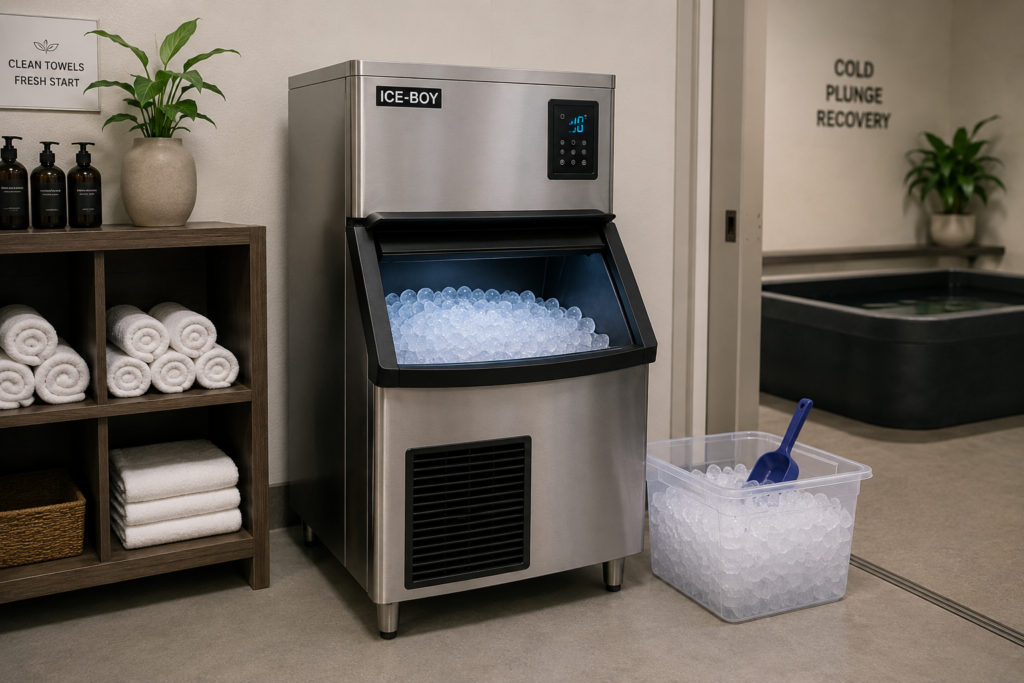
Production Capacity and Stored Ice Are Different
Including both dice and bullet machines makes the distinction between production and storage particularly clear.
The SQ-65 is rated at 30 kg/day with 18 kg storage, while the SQ-120 increases rated production to 55 kg/day but retains 18 kg storage.
A similar pattern appears in the bullet range. The BVM-130 provides 60 kg/day with 25 kg storage, while the BVM-210 increases production to 95 kg/day with 26 kg storage.
Higher daily production therefore does not necessarily mean a proportionately larger quantity of finished ice is available at one time.
For wellness facilities with scheduled recovery sessions, the distinction is operationally important. A machine may have sufficient daily output but still require adequate stored ice before a concentrated appointment block begins.
The BUZ-330, at 140 kg/day with 60 kg storage, introduces a larger storage step where measured peak withdrawal justifies the additional reserve.
Machine comparison should therefore address two separate requirements:
How much ice must the facility manufacture during the operating day?
and
How much finished ice must be available before the highest-demand period begins?
Both figures should be established before the final model and ice format are selected.
Where Should the Ice Machine Sit in a Wellness Center?
Machine placement should support production performance, hygiene, serviceability and efficient transfer to the point of use.
A commercial ice machine does not need to occupy guest-facing treatment space. A service room, recovery support area or appropriately designed back-of-house location may provide a more controlled installation.
The proposed location should provide:
- suitable water supply
- drainage
- electrical infrastructure
- ventilation
- cleaning access
- service access
- practical transfer to the recovery or beverage area
Operating temperature also affects output.
Ice-boy’s current technical catalogue states that daily production ratings are based on 10°C air and 10°C water. At 32°C air and 25°C water, production is stated to be approximately 30% lower. The catalogue also lists a recommended ambient operating range of 10°C to 38°C.
The approximately 30% reduction applies to those specific comparison conditions and should not be treated as a universal correction factor.
It does demonstrate that ambient and incoming-water temperatures should be considered when rated output is compared with measured demand.
Hygiene Depends on How the Ice Is Used
Ice used in guest beverages forms part of the facility’s food-handling operation.
FSSAI requirements specify that ice used in direct contact with food should be made from potable water and produced, handled and stored in a manner that prevents contamination.
For beverage applications, controls should cover:
- potable incoming water
- protected ice storage
- dedicated scoops
- clean transfer containers
- routine cleaning of ice-contact surfaces
- prevention of direct hand contact
Recovery or treatment ice should follow the wellness center’s documented operating and hygiene procedures for that service.
Where one machine supplies both applications, dedicated containers and utensils can maintain separation after the ice leaves the machine.
Can One Machine Supply Both Recovery Ice and Beverage Ice?
A single machine may support both applications where its production, storage and ice format meet the combined requirement.
The two demand streams should still be measured separately so that overlapping peaks remain visible.
A combined installation should be assessed against:
- total daily production
- peak combined withdrawal
- available storage
- replenishment between demand periods
- transfer distance
- handling requirements for each use
This determines whether one machine can support the complete wellness operation without creating a shortage during periods when recovery and beverage demand occur simultaneously.
What to Check Before Buying an Ice Machine for a Spa
The procurement specification should convert operating data into measurable equipment requirements.
Production should be based on recorded recovery and beverage consumption. Storage should be based on the quantity that must be ready before the busiest service block.
The proposed installation should then be assessed for water supply, drainage, electrical requirements, ventilation, ambient conditions, cleaning access and service access.
Finally, the facility should define the required ice format, transfer method, separation of beverage and recovery handling, and responsibility for routine cleaning.
These factors can be reduced to four specification areas:
production requirement → peak storage requirement → installation conditions → handling requirements
Ice-boy’s commercial ice machine capacity guide provides an additional capacity-planning reference. Existing machines can be supported through Ice-boy’s Service Support channel.
Frequently Asked Questions
Do all spas and wellness centers need an ice machine?
Commercial ice production is relevant where the facility has recurring, measurable physical-ice demand. A spa with limited beverage requirements and no ice-dependent recovery operation may not require dedicated high-capacity equipment.
Can an ice machine replace a cold-plunge chiller?
No. An ice machine manufactures physical ice, while a plunge chiller removes heat from water and controls the temperature of the plunge system. Their functions should be specified separately.
How much ice does a wellness center need per day?
Daily capacity should be based on measured consumption. Recovery ice should be recorded per relevant session, beverage consumption measured separately, and both requirements assessed against the busiest operating period.
Which Ice-boy machine should a wellness center consider?
The suitable model depends first on the required ice format and then on measured production and storage demand.
The representative Ice-boy machines evaluated in this guide range from the SQ-65 dice machine at 30 kg/day to the BUZ-330 bullet machine at 140 kg/day. Dice ice is a valid option where that format suits the application; bullet ice should not be treated as the default requirement for spas or wellness centers.
Can the same machine supply recovery and beverage ice?
One machine may support both applications where production, storage and ice format meet the combined requirement. Separate handling procedures should be maintained after the ice leaves the machine.
Does ice used in guest beverages need to be made from potable water?
Yes. FSSAI specifies that ice used in direct contact with food should be made from potable water and handled and stored to prevent contamination.
Size an Ice-boy Machine Around the Wellness Operation
Commercial ice-machine selection for a spa or wellness center should be based on measurable operating requirements: physical ice consumption, concentration of scheduled sessions, beverage demand, peak storage needs and installation conditions.
Once these requirements are established, the relevant Ice-boy production and storage capacities can be compared without relying on generalized estimates based on guest count or facility size.
Request an Ice-boy ice machine recommendation for your spa or wellness center