
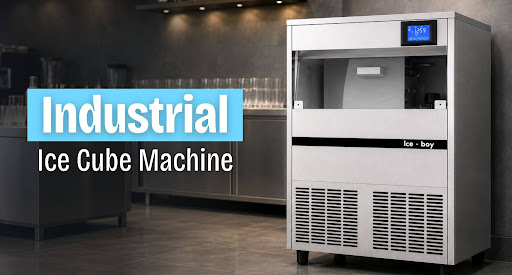
- An industrial ice cube machine is a high-capacity ice production system designed to manufacture large quantities of ice continuously for.
- The terms commercial and industrial are often used interchangeably, but they are not the same.
- Commercial machines are designed for businesses such as:.
- Industrial systems are built for businesses where ice production itself becomes part of the core operation.
- Production capacity is one of the most important factors when selecting an industrial ice machine.
The demand for industrial ice production has grown rapidly across India over the last decade. What was once considered equipment used only by large hotels and food factories has now become an essential part of operations for packaged ice manufacturers, beverage companies, cold chain businesses, hospitals, pharmaceutical facilities, and commercial catering operations.
As businesses expand, so does their daily requirement for reliable, hygienic, and high-volume ice production. Producing 50 kilograms of ice per day is very different from producing 500 or even 1,000 kilograms consistently without interruptions. At this scale, machine design, freezing technology, energy efficiency, and maintenance become just as important as production capacity.
This is where an industrial ice cube machine differs significantly from standard commercial equipment.
Unlike smaller ice makers that support restaurants or cafés, industrial systems are engineered for continuous production, heavy-duty workloads, and consistent performance under demanding conditions. They are designed to deliver uniform ice quality every day while minimizing downtime and operating costs.
If you’re researching an industrial ice making machine, comparing different production capacities, or planning a large-scale ice manufacturing setup, this guide will help you understand how industrial ice systems work, which industries rely on them, and what factors should influence your buying decision.
What Is an Industrial Ice Cube Machine?
An industrial ice cube machine is a high-capacity ice production system designed to manufacture large quantities of ice continuously for commercial and industrial applications.
Unlike residential or small commercial ice makers, industrial machines are built to operate for extended hours with minimal interruption while maintaining consistent ice quality.
Their primary purpose is not simply to produce more ice. They are designed to provide dependable production that supports businesses where ice is an operational necessity rather than an occasional requirement.
Depending on the model, an industrial machine may produce anywhere from 100 kilograms to well over 1,000 kilograms of ice every day, making it suitable for businesses that require a constant and uninterrupted supply.
These systems are commonly installed in:
- Packaged ice manufacturing plants
- Beverage production facilities
- Hotels and resorts
- Food processing units
- Catering kitchens
- Hospitals
- Cold chain operations
Modern industrial machines also incorporate advanced freezing systems, automated controls, and hygienic production methods to ensure that every batch of ice meets consistent quality standards.
Industrial vs Commercial Ice Machines
The terms commercial and industrial are often used interchangeably, but they are not the same.
Both produce ice automatically, yet they are built for different levels of operation.
Commercial Ice Machines
Commercial machines are designed for businesses such as:
These businesses require reliable daily production, but their demand is generally measured in tens or a few hundred kilograms per day. Commercial machines prioritize:
- Compact installation
- Fast production
- Easy maintenance
- Moderate production capacity
They are ideal where ice supports operations but is not the primary product being sold.
Industrial Ice Machines
Industrial systems are built for businesses where ice production itself becomes part of the core operation. Examples include:
- Packaged ice manufacturers
- Food factories
- Beverage bottling plants
- Large hospitality groups
- Pharmaceutical industries
These machines differ in several important ways.
Much Higher Production Capacity
Industrial systems are designed for continuous production over long operating hours. Instead of producing enough ice for one restaurant, they may support:
- Multiple commercial clients
- Distribution networks
- Factory operations
- Large hospitality facilities
Their production capacity is significantly higher and designed to remain consistent even during peak demand.
Continuous Operation
Many commercial machines operate efficiently throughout the business day. Industrial machines, however, are expected to perform almost continuously.
Some facilities run production around the clock during peak seasons, requiring machines capable of maintaining output without frequent shutdowns.
This places much greater demands on compressors, refrigeration systems, water circulation, and structural components.
Stronger Construction
Industrial machines are built using heavy-duty materials that withstand demanding environments. These systems are expected to:
- Handle continuous production
- Resist corrosion
- Operate in warm environments
- Support long service life
Durability is particularly important because downtime in industrial operations often results in delayed deliveries, lost revenue, and dissatisfied customers.
Advanced Automation
Most industrial systems incorporate automation features that improve production consistency and reduce manual intervention. These may include:
- Automatic production cycles
- Smart monitoring
- Ice thickness adjustment
- Operational diagnostics
- Safety alerts
Automation improves both efficiency and reliability while simplifying daily operation.
Related Read:
Typical Production Capacities
Production capacity is one of the most important factors when selecting an industrial ice machine. Choosing capacity based only on today’s demand often creates operational challenges as businesses grow.
Typical ranges include:
| Daily Production | Typical Business |
| 100–200 kg/day | Large cafés, restaurants, boutique hotels |
| 200–500 kg/day | Hotels, catering companies, commercial kitchens |
| 500–800 kg/day | Packaged ice businesses, beverage distributors |
| 800–1000+ kg/day | Industrial manufacturing, food processing, large distribution operations |
Businesses should always consider:
- Current production
- Peak seasonal demand
- Expected business growth
- Future customer expansion
Selecting slightly higher capacity often proves more cost-effective than replacing equipment within a few years.
Industries That Use Industrial Ice Cube Machines
Industrial ice production is no longer limited to hospitality. Today, many industries rely on consistent ice supply to support daily operations.
Each industry uses ice differently, which also influences the type of machine and production capacity required.
Hotels and Resorts
Large hotels consume remarkable amounts of ice every day. Unlike restaurants that primarily serve beverages, hotels use ice across multiple departments simultaneously.
These include:
- Restaurants
- Cocktail bars
- Banquet halls
- Room service
- Poolside beverage stations
- Conference facilities
A single wedding or conference event may require several hundred kilograms of ice within a few hours.
Because demand fluctuates throughout the day, hotels require machines capable of maintaining consistent production without compromising ice quality.
Reliable industrial systems help reduce dependency on external suppliers while ensuring every department has uninterrupted access to ice.
Packaged Ice Manufacturers
Packaged drinking ice has become one of the fastest-growing segments of the commercial ice industry. Consumers increasingly purchase packaged ice for:
- Home parties
- Outdoor events
- Beverage retailers
- Convenience stores
- Catering businesses
Unlike hospitality businesses, packaged ice manufacturers are producing ice as their primary product. This means every kilogram of ice directly contributes to revenue.
Industrial machines support these businesses by offering:
- Continuous production
- Crystal-clear ice quality
- Consistent cube size
- Reliable daily output
Production consistency is especially important because packaged ice brands depend heavily on customer trust and product appearance.
Food Processing Companies
Food processing facilities use ice as an important part of temperature management. Ice helps:
- Maintain food safety
- Reduce bacterial growth
- Preserve freshness during processing
- Support seafood and meat handling
- Maintain cold chain standards
Unlike beverage businesses, these facilities prioritize production reliability and hygiene over presentation.
Industrial ice machines help maintain uninterrupted processing schedules while meeting food-grade standards.
Beverage Manufacturers
Large beverage companies often require significant quantities of ice during:
- Product testing
- Packaging
- Storage
- Promotional events
- Distribution
Maintaining consistent ice quality ensures stable cooling and predictable operational performance.
Industrial machines allow manufacturers to produce large quantities without relying on external vendors.
Hospitals and Healthcare Facilities
Hospitals use industrial ice production for multiple purposes beyond patient beverages. Ice supports:
- Patient care
- Medical storage
- Cold therapy
- Laboratory operations
- Emergency response
Healthcare environments require machines that prioritize hygiene, reliability, and easy cleaning because ice often supports patient-related applications.
Catering and Event Companies
Large catering businesses rarely experience consistent demand. Their production requirements change depending on:
- Event size
- Outdoor temperatures
- Beverage menus
- Guest count
Industrial ice machines help caterers prepare for large events while reducing dependence on third-party ice suppliers.
Having an in-house production system also improves scheduling flexibility and lowers long-term operating costs.
How Industrial Ice Cube Machines Work
Although industrial machines vary in size and production capacity, the overall production process follows a structured sequence designed for efficiency, consistency, and continuous operation.
Understanding how these systems work helps buyers appreciate why industrial equipment differs significantly from smaller commercial machines.
Step 1: Water Filtration
The process begins with water quality. Before freezing begins, water passes through filtration systems that remove:
- Sediments
- Minerals
- Odors
- Impurities
Clean water is essential because it directly affects:
- Ice clarity
- Taste
- Machine lifespan
- Hygiene standards
Many industrial setups also include RO systems and water softeners depending on local water quality.
Step 2: Controlled Freezing Process
Filtered water is circulated through the evaporator where refrigeration technology gradually freezes it into the desired ice shape.
The quality of this freezing stage determines:
- Ice density
- Crystal clarity
- Structural strength
- Melt rate
Advanced freezing technology ensures that every production cycle delivers uniform, high-quality ice instead of irregular or cloudy cubes.
Step 3: Automatic Ice Harvesting
Once freezing is complete, the machine automatically releases finished ice from the evaporator into the storage bin.
The harvesting process is fully automated, allowing the production cycle to begin again immediately.
This continuous cycle enables industrial machines to maintain high daily production without constant operator involvement.
Step 4: Storage and Continuous Production
Finished ice is transferred into insulated storage bins where it remains ready for packaging or use. Modern industrial machines continuously monitor storage levels.
When ice is removed, production automatically resumes, ensuring a steady supply throughout the day.
This automation reduces manual monitoring while maximizing productivity.
Types of Industrial Ice Cube Machines
Not every industrial business uses the same type of ice. A five-star hotel, a packaged ice manufacturer, a seafood processing plant, and a beverage company all have different operational requirements. This is why industrial ice machines are available in multiple configurations, each designed to produce a specific type of ice.
Selecting the wrong ice type can impact everything from cooling efficiency and beverage quality to production costs and customer experience. Before investing in an industrial machine, businesses should understand how each ice type performs and where it delivers the most value.
Bullet Ice Machines
Bullet ice machines are among the most versatile commercial and industrial ice-making systems available today.
Bullet ice is recognizable by its rounded cylindrical shape with a hollow center. This design allows the ice to cool beverages quickly while enabling faster production cycles compared to some other ice formats.
Because bullet ice can be produced efficiently, these machines are ideal for businesses where large quantities of fresh ice are required throughout the day.
They are commonly used in:
- Cafés
- Coffee chains
- Juice bars
- Quick-service restaurants
- Beverage kiosks
- Corporate cafeterias
One of the biggest advantages of industrial bullet ice machines is production speed. Businesses that experience continuous customer traffic need machines capable of replenishing ice quickly without compromising consistency.
Related Read:
- Ice Machine for Hospital: Types, Prices & Buying Guide
- Ice Machine for Laboratory: Best Ice Machines for Labs
- Best Ice Cube Making Machines for Hotels and Bars
Modern industrial bullet ice machines also incorporate advanced evaporator technology that improves:
- Ice density
- Structural consistency
- Production efficiency
- Long-term reliability
Instead of producing soft, poorly formed ice that melts rapidly, advanced freezing systems create stronger bullet ice that performs significantly better in commercial beverage service.
Dice Ice Machines
Dice ice machines are designed for businesses that prioritize versatility and high-volume production.
Unlike bullet ice, dice cubes are solid and uniform, making them suitable for a wider variety of commercial applications.
Dice ice is widely used across:
- Hotels
- Banquet kitchens
- Restaurants
- Food processing units
- Packaged ice manufacturers
- Catering businesses
The biggest advantage of dice ice is its balance between cooling performance and storage efficiency.
Because the cubes have consistent dimensions, they:
- Stack efficiently during storage
- Are easier to package
- Transport well
- Perform consistently across different applications
For businesses producing packaged drinking ice, dice ice often becomes the preferred choice because customers associate uniform, crystal-clear cubes with premium quality.
Industrial dice ice machines are also capable of maintaining production consistency over long operating hours, making them suitable for businesses supplying multiple commercial clients every day.
Gourmet Ice Machines
Gourmet ice is designed for businesses where beverage presentation is as important as cooling performance.
These machines produce dense, crystal-clear cubes that melt much more slowly than standard commercial ice.
Luxury hotels, premium cocktail bars, fine dining restaurants, and high-end beverage brands frequently choose gourmet ice because it enhances the overall drinking experience.
Its slower melt rate helps:
- Preserve beverage flavor
- Reduce unnecessary dilution
- Improve drink presentation
- Increase perceived product quality
Although gourmet ice machines generally produce lower volumes than industrial bullet or dice systems, they create significantly higher value for businesses serving premium beverages.
For establishments where every cocktail or premium drink contributes to brand perception, gourmet ice becomes an investment in customer experience rather than simply another operating expense.
Custom Industrial Ice Solutions
Large industrial businesses rarely fit into standard categories.
Food processing companies, pharmaceutical manufacturers, cold chain businesses, seafood exporters, and beverage production facilities often require customized ice production systems designed around their workflow.
Instead of purchasing a single machine, these businesses may install complete ice production systems that include:
- High-capacity ice makers
- Water treatment plants
- Automated storage bins
- Ice crushers
- Packaging systems
- Conveyor integration
- Remote monitoring systems
These integrated solutions allow businesses to automate large portions of production while maintaining consistent quality across every batch.
As production volume increases, designing the entire system becomes more important than simply choosing an individual machine.
Industrial Ice Cube Machine Capacity Guide
Capacity planning is one of the most critical decisions when purchasing an industrial ice machine.
Surprisingly, many businesses either underestimate future demand or purchase machines significantly larger than necessary. Both mistakes increase operational costs and reduce profitability.
Instead of focusing only on today’s requirements, businesses should estimate production based on:
- Current customer demand
- Peak seasonal requirements
- Expected business growth
- Distribution expansion
- Future product offerings
The following guide provides a practical starting point.
| Daily Ice Production | Recommended Applications |
| 100–200 kg/day | Large cafés, boutique hotels, restaurants, juice chains |
| 200–500 kg/day | Hotels, resorts, catering companies, commercial kitchens |
| 500–800 kg/day | Packaged ice businesses, beverage distributors, seafood suppliers |
| 800–1000+ kg/day | Industrial ice factories, food processing plants, pharmaceutical logistics, cold chain operations |
However, choosing capacity is about much more than matching numbers.
100–200 kg Per Day
Businesses in this category generally require consistent commercial production without entering full-scale industrial manufacturing.
Typical users include:
- Premium cafés
- Multi-outlet restaurants
- Boutique hotels
- Corporate cafeterias
These businesses often experience predictable daily demand with moderate seasonal fluctuations. Machines in this category should prioritize:
- Energy efficiency
- Compact footprint
- Reliable daily production
- Easy maintenance
200–500 kg Per Day
This range is suitable for businesses experiencing continuous commercial demand.
Examples include:
- Large hotels
- Banquet facilities
- Catering businesses
- Restaurant groups
These operations often require ice throughout multiple departments simultaneously.
Production reliability becomes more important than simply achieving maximum output because interruptions affect several operational areas at once.
500–800 kg Per Day
Businesses supplying external customers generally fall into this category.
These include:
- Packaged drinking ice manufacturers
- Beverage wholesalers
- Commercial ice distributors
At this scale, production consistency directly influences revenue. Machines should be capable of operating continuously while maintaining:
- Uniform ice quality
- Stable production cycles
- Low maintenance downtime
Storage planning also becomes increasingly important because production often exceeds immediate dispatch requirements.
800–1000+ kg Per Day
Large-scale industrial operations require machines engineered specifically for continuous manufacturing environments.
Typical applications include:
- Ice manufacturing plants
- Food processing factories
- Pharmaceutical logistics
- Cold chain operations
- Seafood export businesses
Businesses at this level should evaluate:
- Future expansion
- Automation capability
- Water treatment infrastructure
- Energy efficiency
- Preventive maintenance systems
Instead of viewing the machine as equipment, these businesses should view it as production infrastructure.
Industrial Ice Cube Machine Price in India
One of the most common questions buyers ask is:
“How much does an industrial ice machine cost?”
The answer depends on several factors because industrial systems are designed around production requirements rather than standard pricing.
The final investment varies depending on:
- Production capacity
- Ice type
- Refrigeration technology
- Automation features
- Storage requirements
- Water treatment systems
As a general guideline:
| Machine Category | Estimated Investment |
| Entry-level commercial systems | ₹1 lakh – ₹3 lakh |
| Mid-capacity industrial systems | ₹3 lakh – ₹10 lakh |
| Large industrial production systems | ₹10 lakh and above |
However, buyers should avoid evaluating machines solely by purchase price.
The true cost of ownership includes:
- Electricity consumption
- Water usage
- Maintenance expenses
- Spare part availability
- Downtime risk
- Machine lifespan
A machine with a higher upfront investment often proves more economical over ten years if it reduces electricity usage, maintenance frequency, and operational interruptions.
When calculating ROI, businesses should consider lifecycle cost rather than purchase cost alone.
Related Read:
What Determines Ice Quality in Industrial Machines?
One of the biggest misconceptions in the industry is that ice quality depends mainly on its shape.
In reality, two machines producing identical-looking cubes can deliver completely different performance. The difference lies inside the machine. Industrial ice quality is determined by several engineering factors working together.
Freezing Technology
The freezing process determines how water transforms into ice.
Advanced freezing systems produce:
- Better crystal formation
- Higher density
- More uniform cubes
- Improved structural strength
Poor freezing systems trap impurities and air bubbles, resulting in cloudy ice that melts more quickly.
This is why freezing technology often has a greater impact than the external shape of the cube itself.
Water Quality
Even the most advanced industrial machine cannot compensate for poor water quality.
Water with high mineral content or impurities affects:
- Ice clarity
- Taste
- Hygiene
- Machine efficiency
Industrial setups should always include proper filtration systems to ensure consistent production quality while protecting internal machine components from scaling.
Ice Density
Dense ice contains fewer trapped air pockets.
This provides several advantages:
- Slower melting
- Better beverage performance
- Longer storage life
- Reduced breakage during handling
High-density ice is particularly valuable for hospitality businesses where beverage quality directly influences customer satisfaction.
Ice Clarity
Clear ice is often viewed as a visual characteristic, but it also reflects production quality. Clear ice indicates:
- Better freezing control
- Cleaner water circulation
- Lower impurity retention
For packaged ice businesses and premium hospitality brands, crystal-clear ice also improves customer perception of hygiene and product quality.
Melt Rate
Ultimately, customers judge ice by how it performs.
Fast-melting ice:
- Dilutes beverages quickly
- Reduces cooling efficiency
- Creates inconsistent customer experiences
Well-engineered industrial machines produce ice with a slower, more controlled melt rate, allowing beverages and stored products to remain colder for longer periods.
This is why experienced buyers evaluate technology before ice shape. A high-quality bullet cube produced using advanced freezing systems often outperforms a poorly manufactured dice cube.
How to Choose the Right Industrial Ice Cube Machine
Buying an industrial ice cube machine is a long-term investment. Unlike smaller commercial appliances that can be replaced relatively easily, industrial systems become part of your production infrastructure. The right machine can support your business for years, while the wrong one can lead to frequent downtime, rising operating costs, inconsistent ice quality, and expensive upgrades.
Rather than comparing machines based only on production capacity or price, businesses should evaluate how the machine fits into their operations, expected growth, and long-term production goals.
Here are the key factors every buyer should consider before making a purchase.
Start with Your Daily Ice Requirement
The first question should never be, “Which machine should I buy?” Instead, ask:
“How much ice does my business actually need every day?”
Many businesses estimate only their current usage and ignore seasonal demand or future expansion. This often results in purchasing machines that become insufficient within a year or two.
Calculate your requirement based on:
- Daily customer volume
- Peak seasonal demand
- Number of operational shifts
- Ice consumption across departments
- Expected business growth over the next three to five years
For example, a packaged ice manufacturer supplying 250 kg per day today may reach 400 kg per day after adding new distributors. Buying a machine that barely meets today’s requirement often leads to another major investment much sooner than expected.
Choosing slightly higher capacity usually provides better long-term value than replacing equipment prematurely.
Match the Machine to Your Industry
Not every industrial business needs the same type of machine.
A hotel, seafood processor, packaged ice factory, and pharmaceutical facility all use ice differently.
Consider how the ice will actually be used.
If your business focuses on:
- Beverage service, prioritize ice quality and presentation.
- Packaged ice production prioritizes consistency and storage efficiency.
- Food processing, prioritize continuous production and hygiene.
- Cold chain logistics, prioritize production capacity and operational reliability.
Selecting a machine designed around your industry improves productivity while reducing unnecessary operating costs.
Evaluate Energy Efficiency Instead of Just Electricity Consumption
Industrial ice machines operate for long hours, making electricity one of the largest ongoing operating expenses. Many buyers compare only the machine’s purchase price and ignore how much it will cost to operate every month.
An energy-efficient machine may initially cost more but often delivers substantial savings over its lifetime through:
- Reduced electricity consumption
- Faster freezing cycles
- Lower compressor workload
- Better refrigeration efficiency
When evaluating machines, calculate the total cost of ownership, not just the purchase cost.
Understand Your Water Quality
Water is the raw material used to produce ice. Its quality directly affects:
- Ice clarity
- Ice taste
- Machine efficiency
- Maintenance frequency
- Equipment lifespan
Areas with hard water or high Total Dissolved Solids (TDS) often experience:
- Mineral deposits
- Scale formation
- Reduced production efficiency
- Frequent servicing
Installing appropriate water filtration and softening systems is often one of the best long-term investments for protecting industrial equipment.
Plan Storage Alongside Production
Many buyers focus entirely on production capacity but overlook storage requirements. Producing 800 kilograms of ice each day is only useful if the business can store that ice properly before dispatch or use.
Storage planning should consider:
- Peak production periods
- Delivery schedules
- Insulated storage bins
- Cold room capacity
- Product rotation
Poor storage planning often results in:
- Ice melting before dispatch
- Product wastage
- Reduced production efficiency
- Higher electricity consumption
Industrial ice production should always be planned as a complete system rather than treating production and storage separately.
Consider Service and Spare Parts Availability
Even the best industrial machine requires periodic servicing. When selecting a supplier, buyers should evaluate:
- Availability of trained service engineers
- Spare part accessibility
- Response time
- Preventive maintenance support
- Warranty coverage
Fast service support minimizes downtime and helps businesses avoid production interruptions that may affect customers.
For operations that depend heavily on continuous ice production, after-sales support can be just as important as the machine itself.
Common Mistakes When Buying an Industrial Ice Machine
Industrial ice systems are designed for long-term production. Mistakes made during the buying stage often continue affecting operations for years. Here are some of the most common purchasing mistakes and how to avoid them.
Choosing Insufficient Production Capacity
One of the most frequent mistakes is purchasing equipment based only on current demand. Businesses often calculate today’s production requirements but ignore:
- Business expansion
- New customer acquisition
- Seasonal demand spikes
- Additional product lines
During peak summer months, demand can increase dramatically. Machines operating at maximum capacity continuously experience greater wear, reduced efficiency, and increased maintenance.
Investing in slightly higher capacity provides operational flexibility while supporting future growth.
Ignoring Water Treatment Requirements
Many buyers invest heavily in industrial equipment but spend very little on water treatment. This is a costly mistake.
Poor water quality causes:
- Cloudy ice
- Scaling inside refrigeration systems
- Higher maintenance costs
- Reduced machine lifespan
- Lower freezing efficiency
Industrial production should always include appropriate filtration, water softening, and regular water quality monitoring.
Clean water benefits both the machine and the finished product.
Underestimating Storage Requirements
Production is only one part of the operation. Businesses also need sufficient cold storage to:
- Handle production peaks
- Maintain product quality
- Organize inventory
- Support delivery schedules
Without adequate storage:
- Ice begins melting before dispatch.
- Packaging quality deteriorates.
- Production schedules become inefficient.
Storage planning should be based on maximum daily production rather than average inventory.
Buying Solely Based on Price
A lower purchase price does not necessarily mean lower operating costs. Cheaper machines often result in:
- Higher electricity usage
- Increased maintenance
- Lower production efficiency
- Shorter equipment lifespan
- More frequent downtime
Industrial buyers should compare:
- Energy efficiency
- Service support
- Spare parts availability
- Machine durability
- Long-term operating cost
The most economical machine is usually the one with the lowest lifetime cost, not the lowest purchase price.
Overlooking Future Automation Needs
As production increases, manual processes become bottlenecks. Many businesses initially purchase standalone machines without considering future integration with:
- Ice storage systems
- Packaging lines
- Conveyor systems
- Automated handling equipment
Planning for future automation reduces expansion costs and improves operational efficiency.
Maintenance Best Practices
Industrial ice machines operate continuously in demanding environments. Regular maintenance is essential for maintaining production quality, reducing unexpected breakdowns, and extending equipment life.
Rather than waiting for problems to appear, businesses should follow a preventive maintenance schedule.
Clean the Machine Regularly
Because ice is a food-grade product, cleanliness directly affects product quality. Regular cleaning helps:
- Prevent bacterial growth
- Remove mineral deposits
- Maintain ice clarity
- Improve hygiene standards
Cleaning schedules should follow manufacturer recommendations and become part of routine operations rather than occasional maintenance.
Replace Water Filters on Time
Water filters gradually lose effectiveness as they trap sediments and impurities. Old filters can lead to:
- Reduced water flow
- Poor ice quality
- Increased scaling
- Additional strain on refrigeration components
Replacing filters at recommended intervals protects both machine performance and finished ice quality.
Perform Scheduled Descaling
In areas with hard water, mineral deposits gradually build up inside the machine. Scaling reduces:
- Heat transfer efficiency
- Production speed
- Energy efficiency
Regular descaling helps maintain optimal freezing performance while reducing long-term repair costs.
Monitor Production Performance
Businesses should routinely monitor:
- Daily production output
- Ice consistency
- Freezing cycle duration
- Water consumption
- Electricity usage
Small changes often indicate developing issues long before major breakdowns occur. Early detection allows preventive servicing instead of emergency repairs.
Schedule Preventive Servicing
Annual or biannual servicing by trained technicians helps identify worn components before they fail. Preventive servicing typically includes:
- Refrigeration system inspection
- Compressor evaluation
- Electrical component checks
- Water circulation inspection
- Safety testing
Routine servicing significantly reduces the risk of unexpected downtime during busy seasons.
Final Thoughts
Choosing an industrial ice cube machine is about far more than purchasing equipment that produces large quantities of ice.
For businesses that depend on consistent ice production, the machine becomes a critical part of daily operations. Its reliability affects customer satisfaction, operating costs, production efficiency, and long-term profitability.
The best industrial system is one that aligns with your production requirements today while providing enough flexibility to support future growth. Capacity, freezing technology, water quality management, energy efficiency, maintenance planning, and service support all play an equally important role in long-term performance.
Instead of selecting a machine based solely on purchase price, businesses should evaluate the complete cost of ownership, expected production needs, and operational reliability. A well-engineered industrial ice machine may require a higher initial investment, but it often delivers greater value through lower maintenance costs, better energy efficiency, consistent ice quality, and longer service life.
Whether you operate a packaged ice business, food processing facility, hospitality group, or industrial manufacturing unit, investing in reliable ice production technology creates a stronger foundation for sustainable growth.
With production capacities ranging from 100 kg to over 1,000 kg per day, advanced freezing technology, industrial-grade construction, and dependable after-sales support, Ice-boy offers scalable solutions designed to meet the evolving needs of commercial and industrial businesses across India.
FAQs
What is an industrial ice cube machine?
An industrial ice cube machine is a high-capacity ice production system designed to produce large volumes of ice continuously for businesses such as hotels, food processing plants, packaged ice manufacturers, and beverage companies.
How much ice can an industrial ice machine produce?
Production capacity varies by model. Industrial machines can produce anywhere from 100 kg to more than 1,000 kg of ice per day, depending on business requirements and machine specifications.
What is the price of an industrial ice cube machine in India?
The price depends on production capacity, technology, automation features, and storage requirements. Larger industrial systems generally require a higher investment than standard commercial ice machines.
Which industries use industrial ice cube machines?
Industrial ice machines are widely used in packaged ice manufacturing, hospitality, food processing, beverage production, healthcare, pharmaceutical logistics, catering, and cold chain businesses.
How do I choose the right industrial ice machine?
Choose a machine based on your daily ice requirement, expected business growth, ice type, energy efficiency, water quality, storage capacity, and availability of service and maintenance support. Planning for future expansion is equally important as meeting current production needs.