
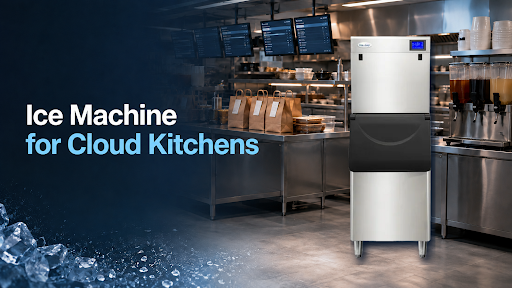
- A cloud kitchen may run several brands from one production space.
- Start with the menu, not the machine catalogue.
- Consider a hypothetical cloud kitchen running three virtual brands.
- Ice Boy’s published catalogue states that its daily ratings are measured at 10°C air and 10°C inlet water.
- Suppose the same kitchen expects 190 ice-using drinks during its busiest 90 minutes, with an average measured ice portion of 0.12 kg:.
Two cloud kitchens can complete the same number of orders and need completely different amounts of ice.
One may sell biryani, rolls and hot meals with very few cold drinks. Another may run three virtual beverage brands from the same kitchen and empty its ice bin during the dinner delivery wave.
That is why order count alone cannot tell you which machine to buy.
The right ice machine for cloud kitchen operations must match the items that actually use ice, the combined demand of every virtual brand and the busiest delivery period. It must also fit the kitchen’s water, drainage, power, ventilation and cleaning plan.
This guide shows you how to calculate those needs and compare suitable Ice Boy models without buying only from a headline capacity number.
Key Takeways
- Do not size an ice machine from total order count alone. Count only the drinks and kitchen tasks that actually use ice across every virtual brand.
- Check two numbers: total ice needed on a busy day and ice needed during the busiest delivery window.
- Published daily production and storage-bin capacity are different. A machine can make enough ice in 24 hours and still run short during a fast dinner rush.
- Ice Boy options worth comparing include the SQ-275, BUZ-330, BUZ-550 and SQ-550.
- Ice Boy specifically lists the BUZ-550 for cloud kitchens and high-volume food and beverage operations, but the right model still depends on measured demand and site conditions.
- Ask for actual-site output, hourly production, warranty, service response and installation requirements in writing before ordering.
Why Cloud-Kitchen Ice Demand Is Different
A cloud kitchen may run several brands from one production space. For example, the same kitchen may prepare:
- Rice bowls under one brand
- Burgers and fries under another
- Iced tea, cold coffee and mocktails under a third
- Meal combinations that include bottled or freshly prepared drinks
All those brands may use the same machine and bin. Demand can also arrive in waves. Online discounts, office lunch orders and weekend evenings can push several brands at the same time.
Before choosing a model, answer three questions:
- Which menu items actually use ice?
- How much ice do all brands use on a busy day?
- How much must be ready before the busiest delivery window?
If your menus rarely use ice, you may not need a commercial machine yet. That is a better conclusion than buying equipment simply because another cloud kitchen has one.
Build One Ice-Use List Across Every Brand
Start with the menu, not the machine catalogue.
Create one list covering every virtual brand. Include only real uses, such as:
- Iced coffee
- Cold tea
- Mocktails and soft drinks served with ice
- Smoothies or blended drinks
- Food preparation steps that require ice under your actual process
- Staff or other measured use, if the same machine supplies it
Do not automatically assign ice to every order. A hot-food order with a sealed beverage may use none.
For each item, measure the ice used in one serving with the team’s normal scoop, cup and recipe.
The basic daily calculation is:
Daily ice demand = quantity of each ice-using item x measured ice per item, added across all brands
Then add any other ice use that you have actually measured.
Repeat it for the busiest delivery window to estimate how much ice should be ready before orders rise.
Worked Example: Three Brands, One Kitchen
Consider a hypothetical cloud kitchen running three virtual brands. Its records from busy days show:
| Shared-kitchen demand | Busy-day quantity | Measured ice per item | Ice required |
|---|---|---|---|
| Brand A cold drinks | 320 | 0.13 kg | 41.6 kg |
| Brand B cold drinks | 240 | 0.10 kg | 24.0 kg |
| Brand C cold drinks | 160 | 0.12 kg | 19.2 kg |
| Other measured kitchen use | — | — | 15.0 kg |
| Total busy-day demand | — | — | 99.8 kg |
The arithmetic is:
(320 x 0.13) + (240 x 0.10) + (160 x 0.12) + 15 = 99.8 kg/day
This is only a planning example. Use your recipes and sales records.
Adjust for the machine’s actual working conditions
Ice Boy’s published catalogue states that its daily ratings are measured at 10°C air and 10°C inlet water. It also states that production at 32°C air and 25°C water is approximately 30% lower. These are Ice Boy’s published figures, not independent test results.
If the example kitchen expects conditions matching that hotter rating, it should compare demand with 70% of the nominal output:
Required nominal capacity = 99.8 / 0.70 = 142.6 kg/day
Under those conditions, 125 kg/day and 140 kg/day models would fall below the calculated requirement. A 250 kg/day model would provide more room.
Do not simply add 30% to demand. A 30% loss leaves 70% of rated output, so division by 0.70 is the correct calculation.
Add any separate buffer for growth, cleaning or unusually busy days only after this adjustment.
Test the dinner delivery wave
Suppose the same kitchen expects 190 ice-using drinks during its busiest 90 minutes, with an average measured ice portion of 0.12 kg:
190 x 0.12 kg = 22.8 kg
The kitchen should have at least that amount ready, plus a practical reserve. A 30 kg bin covers 22.8 kg on paper, but leaves only 7.2 kg of margin and may not be full when the rush starts.
This is why storage matters alongside daily production.
Bullet Ice or Dice Ice for a Cloud Kitchen?
Choose the ice shape from the menu and serving method.
Bullet ice
Bullet ice can work for takeaway cold drinks, iced coffee, mocktails and general beverage service. Ice Boy offers the BUZ range for bullet ice production.
Dice ice
Dice ice is a familiar cube format that works across soft drinks, cold coffee and other commercial beverage service. Ice Boy offers the SQ range for dice ice.
Test the actual cup, lid, straw, scoop and recipe. Confirm cube size and weight with Ice Boy.
For a full ice-shape comparison, read Ice Boy’s guide to clear ice, bullet ice and dice ice.
Ice Boy Models to Compare for Cloud Kitchens
The following specifications are published on Ice Boy’s current product pages.
| Ice Boy model | Ice type | Published output | Storage | Rated power | Published dimensions |
|---|---|---|---|---|---|
| SQ-275 | Dice | 125 kg/day | 30 kg | 0.75 kW | H960 x W655 x D660 mm |
| BUZ-330 | Bullet | 140 kg/day | 60 kg | 0.75 kW | H1100 x W730 x D730 mm |
| BUZ-550 | Bullet | 250 kg/day | 150 kg | 1.15 kW | H1600 x W700 x D840 mm |
| SQ-550 | Dice | 250 kg/day | 200 kg | 1.45 kW | H1675 x W700 x D910 mm |
Ice Boy’s food and beverage page specifically recommends the BUZ-550 for cloud kitchens and high-volume food and beverage operations. Treat that as Ice Boy’s recommendation, not proof that it suits every cloud kitchen.
Use the SQ-275 or BUZ-330 as starting points only when measured demand fits their output and bins. Compare the larger BUZ-550 and SQ-550 where combined demand or required ready storage is higher. The 250 kg/day models still differ in ice shape, storage, power and dimensions, so confirm the complete site fit.
The standard BUZ-330 and BUZ-550 models should be treated as ice makers. Although copied text on their current product pages mentions simultaneous crushed ice, built-in crushing is associated with separate C-suffix combination models in Ice Boy’s catalogue. Confirm the exact model code and functions in the quotation.
Daily Production Is Not Ready Storage
Production tells you how much ice a machine is rated to make over a day under stated conditions. Storage tells you how much finished ice the bin can hold.
They answer different questions:
- Daily production: Can the machine replace all the ice used across the day?
- Ready storage: Is enough ice available when several brands become busy together?
A 125 kg/day machine does not guarantee that 125 kg is waiting in the bin. Production happens over time. The bin may also be partly empty because ice was used earlier.
Ask Ice Boy for expected hourly production under your room and inlet-water temperatures. Ice Boy’s public pages do not publish hourly recovery figures for these models, so do not convert kg/day into kg/hour by simply dividing by 24.
One Larger Machine or a Split Backup Setup?
One larger machine can simplify installation, cleaning and staff training. It may also use less floor space than two separate units.
If the only machine stops, every brand sharing it may lose its ice supply.
Two smaller machines can offer flexibility:
- One unit may support part of the demand while the other is serviced.
- Cleaning can sometimes be planned without losing the entire supply.
- Different ice shapes can support different menus if required.
- Demand can be divided between preparation areas.
Two machines also need more connections, cleaning, maintenance and space. Choose based on downtime cost and service support. Write down a backup plan, such as a safe packaged-ice supplier or service arrangement.
Installation Checks for a Shared Kitchen
An ice machine needs more than an empty corner.
Check the proposed location for:
- Correct electrical supply
- Potable inlet water at the required pressure
- Drainage and floor protection
- Ventilation around the machine
- Distance from ovens, fryers and other heat sources
- Safe access for filling, cleaning and service
- Enough space for doors, panels and removable parts
- A clear route for hygienic ice handling
Cloud kitchens can be hot and crowded. Ask Ice Boy to confirm the installation conditions, current engineering drawing and required clearances in writing.
Treat Ice as Food
Ice goes directly into drinks and may touch food or food-contact equipment. It should be handled with the same care as other ingredients.
The FSSAI food safety regulations include hygienic and sanitary practices for food businesses. For daily operation:
- Start with potable water.
- Test the actual inlet water and choose treatment from the result.
- Clean the machine and bin using the approved method.
- Keep scoops clean and stored safely.
- Do not handle ice with bare hands or drinking glasses.
- Prevent raw-food work, splashes and waste from contaminating the ice area.
- Record cleaning and maintenance.
Machine features do not replace safe handling and scheduled care.
Get These in Writing Before You Order
Ask Ice Boy or the supplying dealer to include the following in the quotation or technical sheet:
- Exact model code and ice type
- Output at your expected room and inlet-water temperatures
- Expected hourly production during the busiest period
- Storage capacity and usable storage arrangement
- Required water quality and treatment system
- Electrical, water, drainage and ventilation needs
- Machine dimensions, service clearances and engineering drawing
- Cleaning method, chemicals and recommended frequency
- Full machine warranty, exclusions and claim process
- Installation, commissioning and staff training included in the price
- Service response time and spare-parts availability for your city
- Backup plan if the machine stops
Ice Boy has a service-support page, but it does not publish a guaranteed response time. Get the support commitment needed by your operation in writing.
Final Thoughts
The best ice machine for cloud kitchen use is not automatically the largest model. It is the machine that matches combined menu demand, the busiest delivery wave, actual site conditions and the kitchen’s backup plan.
Start by measuring ice per menu item across every virtual brand. Calculate the total for a busy day. Then calculate what must be ready before the strongest delivery period. Compare both figures with site-adjusted production and storage.
The SQ-275, BUZ-330, BUZ-550 and SQ-550 give cloud kitchens a useful range of dice and bullet ice options. Ice Boy specifically positions the BUZ-550 for cloud kitchens, but the final choice should still be supported by your figures and a site-specific written quotation.
Share your menu counts, measured ice portions, busiest delivery window, room temperature, inlet-water temperature and available space with Ice Boy India. Those details will lead to a better recommendation than order count alone.
Frequently Asked Questions
How do I calculate ice demand for a cloud kitchen?
List every menu item that uses ice across all virtual brands. Multiply the busy-day quantity of each item by its measured ice portion, add the results and include other measured uses. Repeat the calculation for the busiest delivery window.
Can I size an ice machine from daily order count?
No. Many orders may use no ice, while one beverage-heavy brand may use a large amount. Size from measured ice-using items instead of total orders.
Which Ice Boy machine is recommended for cloud kitchens?
Ice Boy’s food and beverage page recommends the BUZ-550 for cloud kitchens and high-volume operations. The correct model still depends on daily demand, peak demand, preferred ice type, storage, space and site conditions.
Is a 125 kg/day ice machine enough for a cloud kitchen?
It may be, but only if measured demand and actual-site output support it. Also test whether the storage bin holds enough ice for the busiest combined delivery period.
Should a cloud kitchen choose bullet ice or dice ice?
Choose according to the menu, cup, lid, straw and serving process. Bullet and dice ice can both support commercial drinks. Test the actual format before ordering.
Is one large ice machine better than two smaller machines?
One machine may save space and simplify maintenance. Two machines may provide backup and operating flexibility. Compare downtime risk, installation needs and total cost before deciding.
Does published production remain the same in a hot kitchen?
Not necessarily. Ice Boy states that output is approximately 30% lower at 32°C air and 25°C water than at its 10°C air and 10°C water rating condition. Ask for expected output at your site.
What should be confirmed before buying?
Confirm actual-site output, hourly production, storage, utilities, water treatment, dimensions, cleaning, warranty, installation, service response and spare-parts support in writing.