
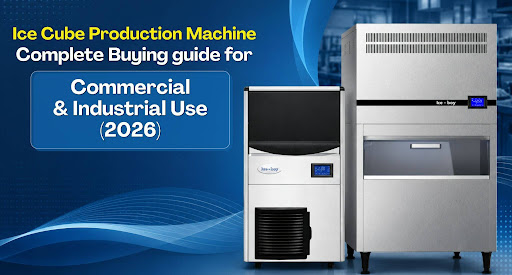
- Most businesses buy an ice cube production machine exactly once every 8 to 10 years, then have to relearn the category from scratch when.
- An ice cube production machine is refrigeration equipment that converts filtered water into shaped ice through a continuous.
- Every ice cube production machine, regardless of shape or size, runs through the same four stages on a loop.
- Machine type is usually the first decision, and it’s driven more by end use than by budget.
- Bullet ice machines produce hollow, cylindrical cubes that freeze fast and cool drinks quickly without diluting them as fast as solid cubes.
Most businesses buy an ice cube production machine exactly once every 8 to 10 years, then have to relearn the category from scratch when it’s time to replace it. That knowledge gap is expensive: an undersized or poorly filtered machine doesn’t just make cloudy ice, it eats into your margins through wasted water, higher power bills, and emergency ice purchases on your busiest day.
India’s ice maker market was valued at roughly $0.50 billion in 2024 and is projected to grow steadily through 2033, driven largely by hotels, quick-service restaurants, and cold-chain expansion in tier-II cities, according to IMARC Group’s market analysis. This guide breaks down how these machines work, which type fits which business, what capacity you actually need, and what you should expect to pay in 2026.
What Is an Ice Cube Production Machine?
An ice cube production machine is refrigeration equipment that converts filtered water into shaped ice through a continuous freeze-and-harvest cycle, storing the output in an insulated bin for on-demand commercial use. Unlike a household freezer tray, it produces ice in batches around the clock, holding a consistent shape, size, and clarity batch after batch.
The category splits broadly into two tiers. Commercial systems are built for cafés, restaurants, and mid-size hotels, typically producing 20 to 250 kg per day from a compact, self-contained unit. Industrial systems serve packaged ice suppliers, fisheries, and large hospitality groups, producing 400 kg to several tonnes per day, often as modular installations feeding a separate storage bin or bagging line.
How Ice Cube Production Machines Work
Every ice cube production machine, regardless of shape or size, runs through the same four stages on a loop.
- Water filtration. Incoming water passes through a sediment and, ideally, a scale-inhibiting filter before it reaches the freezing chamber. This step determines how clear the finished ice looks and how long the evaporator lasts.
- Freezing cycle. A refrigerant-cooled evaporator plate or centrifugal splasher freezes a thin layer of water repeatedly until it builds into a solid cube, bullet, or dice shape. Cycle time typically runs 15 to 30 minutes depending on machine size and ambient temperature.
- Ice harvesting. A brief warm-gas or hot-water pulse releases the formed ice from the mold so it drops into the storage bin, and the cycle restarts immediately.
- Storage systems. An insulated bin holds finished ice at a stable temperature, with a bin-full sensor that pauses production once storage is at capacity, so the machine doesn’t overproduce and waste power.
Related Read: All Bullet Ice Is NOT the Same
Types of Ice Cube Production Machines
Machine type is usually the first decision, and it’s driven more by end use than by budget.
Bullet Ice Machines
Bullet ice machines produce hollow, cylindrical cubes that freeze fast and cool drinks quickly without diluting them as fast as solid cubes. They’re the default choice for cafés and bars that need high turnover and fast chilling. Ice-boy’s bullet shape range spans 18 to 800 kg/day, built on a vertical evaporator system with no gear motors or moving paddles inside the freezing chamber.
Gourmet Ice Machines
Gourmet machines produce large, dense, crystal-clear cubes or spheres that melt slowly, the standard for premium cocktail service in 5-star hotels and upscale bars. These typically run on a centrifugal or slow-freeze system rather than a fast-cycle plate, which is why gourmet units cost more per kg of output than bullet or dice machines of the same capacity.
Dice Ice Machines
Dice (square) ice machines sit between bullet and gourmet in both clarity and cost, and are the most common choice for restaurants, mid-size hotels, and buffet or salad-bar display. Dice-shape models generally cover 18 to 500 kg/day, making them the widest capacity range of any single machine type.
Industrial Ice Production Systems
Industrial systems are built for packaged ice factories, fisheries, and large-scale commercial supply chains that need continuous output above 400 kg/day, sometimes into multiple tonnes. These are usually paired with separate bagging, crushing, or bulk storage equipment rather than sold as a single standalone unit. Ice-boy’s crusher and slicer range processes up to 500 kg/hour for exactly this segment.
Industries That Use Ice Cube Production Machines
- Hotels & restaurants: banquet service, minibars, and beverage counters need continuous, presentable ice.
- Bars & cafés: fast cooling and high turnover during peak hours matter more than ice appearance alone.
- Hospitals & laboratories: controlled, hygienic cooling for sample and specimen storage.
- Food processing & fisheries: ice preserves freshness during transport and display without contaminating the product.
- Packaged ice businesses: high-volume, continuous production feeding a bagging or delivery operation.
- Catering & events: portable or mid-capacity machines that can handle unpredictable peak demand.
Related Read:
- Best Ice Machine for Bar: A Complete Buying Guide
- Ice Machine for Hospital: Types, Prices & Buying Guide
- Ice Machine for Gym: Best Ice Machines for Fitness Centers
- Ice Machine for Laboratory: Best Ice Machines for Labs (2026 Guide)
Ice Cube Production Machine Capacity Guide
Sizing by daily output, in kilograms, is the fastest way to shortlist a machine. As a rough industry benchmark, hotels with a bar and restaurant should plan for roughly 1.5 to 2 kg of ice per guest per day, according to Hospiverse India’s 2026 buying guide, with peak events multiplying that by three or four.
| Daily Production | Best For |
| 20–60 kg/day | Small cafés, home bars |
| 100–250 kg/day | Restaurants & bars |
| 400–800 kg/day | Hotels & catering operations |
| 1,000+ kg/day | Industrial & packaged ice production |
Note: Always size for your daily baseline, not peak demand. Plan for occasional emergency sourcing on your three or four busiest days a year rather than buying a machine that sits idle the rest of the time.
Ice Cube Production Machine Price in India
Price tracks capacity and evaporator technology more than brand alone. Here’s what the market looks like in 2026.
| Machine Type | Estimated Price |
| Small commercial | ₹25,000 – ₹80,000 |
| Mid-range commercial | ₹80,000 – ₹2,50,000 |
| Industrial systems | ₹3,00,000+ |
Note: Imported machines from Japan or the US typically sit 35–50% above Indian-manufactured equivalents of the same capacity, largely due to import duty and slower spare-parts turnaround.
Related Read:
What Determines Ice Quality?
Ice quality comes down to four factors, and water filtration is the one buyers underestimate most. Indian municipal water typically carries a total dissolved solids (TDS) reading of 200 to 800 ppm, well above the 100–150 ppm range that keeps evaporator plates clean, per Hospiverse India’s technical review. Left unfiltered, that gap causes visible scale buildup and can cut ice output by up to 40 percent over time.
- Technology vs. ice shape: Centrifugal and vertical-evaporator systems generally produce clearer ice than basic plate-freeze units, because they don’t rely on internal pumps or paddles that trap air bubbles.
- Ice clarity: Clear ice means slower, more even melting, and fewer visible impurities in the glass.
Density & melt rate: Denser ice holds a drink’s temperature longer without watering it down, which is why gourmet and bullet shapes dominate premium beverage service.
Water filtration: A pre-filter isn’t optional in most Indian cities. It’s the single cheapest upgrade that protects both ice clarity and machine lifespan.
How to Choose the Right Ice Production Machine
Five variables decide the right machine for your business, roughly in this order of importance.
1. Daily demand: Estimate your actual daily ice consumption on a normal day, then size to that baseline, not your busiest weekend.
2. Space requirements: Confirm floor space, ventilation clearance, and drainage before you shortlist models. Undercounter and modular units solve most space-constrained kitchens.
3. Power consumption: Look for start-stop technology and self-cleaning cycles, which reduce standby power draw during low-demand hours.
4. Water quality: Get your local water tested for TDS before installation. It changes both your filtration needs and your machine’s expected service interval.
5. Maintenance support: Confirm spare-parts turnaround and service response time in your city before you buy, not after something breaks.
Common Mistakes Businesses Make
- Buying low-capacity machines: Undersizing is the most common procurement mistake in the category. A machine running at capacity all day has no buffer for a busy Saturday.
- Ignoring water filtration: Skipping a pre-filter to save a few thousand rupees upfront routinely costs far more in reduced output and early evaporator replacement.
- Choosing based only on price: The cheapest machine on paper is rarely the cheapest machine over a 5-year ownership period once you factor in service and water costs.
- Underestimating storage needs: A high-output machine paired with a small storage bin still runs out of ice during peak service.
Maintenance Tips for Long-Term Performance
- Most service calls trace back to a missed cleaning cycle, not a manufacturing defect. A few habits protect both ice quality and machine lifespan.
- Regular cleaning: Wipe down the storage bin and exterior weekly to prevent bacterial buildup and odor transfer to the ice itself.
- Descaling: Run a full descale every 3 to 6 months, more often in high-TDS regions, to keep evaporator plates free of mineral buildup.
- Filter maintenance: Replace water filters on the manufacturer’s schedule, not when output visibly drops. By then, some damage is usually already done.
- Preventive servicing: An annual maintenance contract catches worn components before they cause unplanned downtime during peak season.
Final Thoughts
Ice quality is one of the few things guests and buyers notice immediately and remember disproportionately. A cloudy, fast-melting drink undercuts an otherwise good meal or service experience just as easily as a clear, dense cube elevates it. Getting the technology and capacity decision right upfront, rather than replacing an undersized machine two years in, is usually the difference between ice production being a background utility and a genuine point of profitability.
Ice-boy has spent 33+ years manufacturing ice cube production machines out of Bhiwadi, Rajasthan, India built on a patented German centrifugal system and vertical evaporator technology, serving over 18,000 customers across 20+ countries. If you’re weighing machine types, capacity, or budget for your own business, our team can help you land on the right fit the first time.
People Also Ask (FAQ)
What is an ice cube production machine?
It’s refrigeration equipment that filters, freezes, and harvests water into shaped ice through a repeating cycle, storing output in an insulated bin. Capacities range from 20 kg/day countertop units to 1,000+ kg/day industrial systems for continuous commercial use.
What is the price of an ice cube production machine in India?
Small commercial machines cost roughly ₹25,000 to ₹80,000, mid-range commercial units run ₹80,000 to ₹2,50,000, and industrial systems start around ₹3,00,000 and scale up with capacity, automation, and evaporator technology.
Which industries use ice cube production machines?
Hotels, restaurants, bars and cafés, hospitals and laboratories, food processing and fisheries, packaged ice suppliers, and catering and events businesses all depend on ice cube production machines for hygienic, on-demand ice supply.
How much ice can a commercial ice machine produce per day?
Small commercial units produce 20 to 60 kg/day, mid-size restaurant and bar machines produce 100 to 250 kg/day, hotel and catering systems reach 400 to 800 kg/day, and industrial packaged-ice plants exceed 1,000 kg/day.
What affects the quality of ice cubes?
Ice clarity and melt rate depend mainly on water filtration quality, the freezing technology used (centrifugal, plate, or auger systems), local water TDS levels, and how consistently the machine is cleaned and descaled.
How often should a commercial ice machine be cleaned?
Most manufacturers recommend a full clean and descale every 3 to 6 months, sooner in high-TDS water areas, since mineral scale on evaporator plates can reduce ice production by up to 40 percent if left unaddressed.