
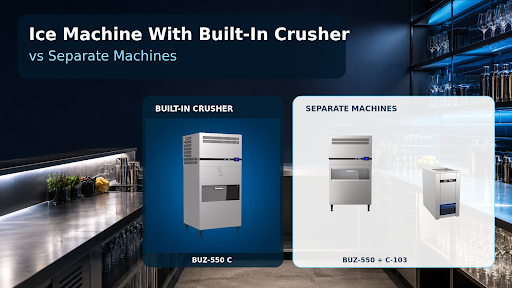
- A commercial ice machine with a built-in crusher makes ice from water and provides crushed ice through the same equipment system.
- The BUZ-550 C has a published production rating of 250 kg/day, 150 kg of storage and a rated power of 1.25 kW.
- The BUZ-900 C increases published production to 400 kg/day and storage to 220 kg.
- The fairest comparison pairs each combination model with its corresponding standard bullet ice maker and then adds either the C-103 or.
- The BUZ-550 C and BUZ-900 C keep ice production, selection and storage within one machine.
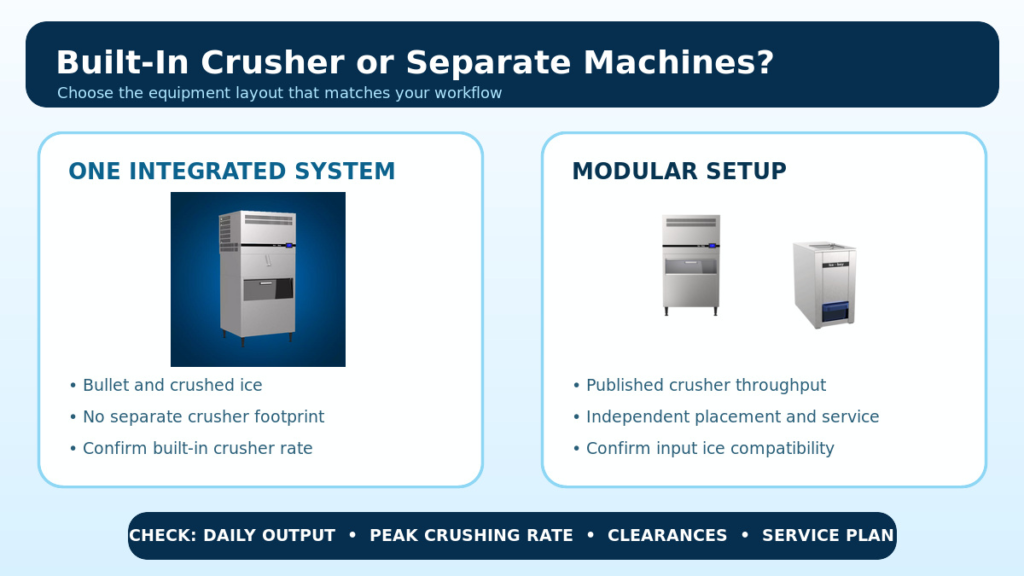
If your business needs both bullet ice and crushed ice, the decision is not simply whether to buy an ice maker or a crusher. The real choice is between one integrated machine and two separate pieces of equipment.
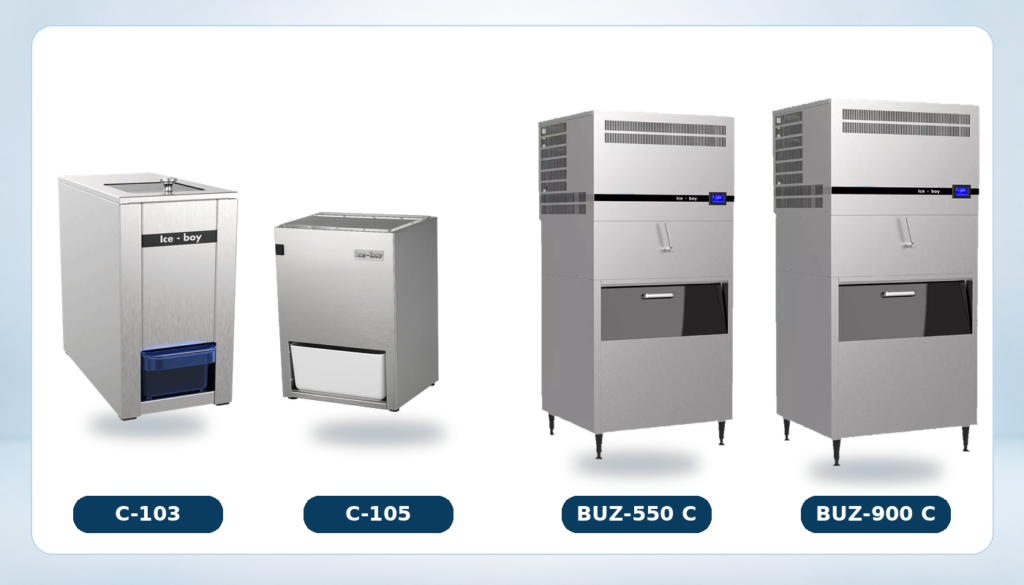
An Ice Boy commercial ice machine with built-in crusher, such as the BUZ-550 C or BUZ-900 C, combines bullet-ice production and crushing capability within one equipment system. A modular setup pairs a standard ice maker, such as the BUZ-550 or BUZ-900, with a C-103 or C-105 crusher.
Neither arrangement is automatically better. The right choice depends on ice shape, daily demand, peak crushing rate, available space, service planning and how ice moves through your operation.
What Is an Ice Machine With a Built-In Crusher?
A commercial ice machine with a built-in crusher makes ice from water and provides crushed ice through the same equipment system. In this article, combination machine means an Ice Boy BUZ-550 C or BUZ-900 C that produces bullet ice and includes crushing capability.
The official product pages describe a selection lever and a partitioned bin. They say users can select bullet ice or crushed ice, or use the partitioned bin to access both forms. The pages do not publish the crusher’s kg/min output, permitted runtime or the exact crushed-to-whole output split
.
That distinction matters. The published 250 kg/day and 400 kg/day figures are ice-making ratings. They should not be interpreted as separate crushing-capacity figures.
Related read: Ice Boy’s existing ice crusher vs ice cube machine guide explains the basic difference between producing ice and crushing existing ice. This article addresses the next decision: integrated or separate equipment.
Ice Boy’s Built-In Crusher Models
BUZ-550 C: 250 kg/day
The BUZ-550 C has a published production rating of 250 kg/day, 150 kg of storage and a rated power of 1.25 kW. Its product page lists storage as 75 kg + 75 kg, supporting the divided-bin description.
At H1920 × W700 × D840 mm, it has the same published width and depth as the standard BUZ-550 but is 320 mm taller. This can reduce the need for a separate crusher footprint, but the additional height and required service clearances still need to be checked on site.
BUZ-900 C: 400 kg/day
The BUZ-900 C increases published production to 400 kg/day and storage to 220 kg. Its rated power is 2.30 kW, with dimensions of H1920 × W900 × D840 mm.
Ice Boy describes the same selection-lever and partitioned-bin arrangement, but it does not publish a numerical storage split for this model. The division between whole and crushed ice should therefore be confirmed in the quotation.
Like-for-Like Ice Boy Setup Comparison
The fairest comparison pairs each combination model with its corresponding standard bullet ice maker and then adds either the C-103 or C-105.
Important website note: the standard BUZ-550 and BUZ-900 product pages contain wording about crushed ice that appears inconsistent with their model names, principal specifications and separate C-suffix listings. The comparison below treats the standard models as maker-only configurations, but Ice Boy should confirm the current specification in writing.
| Configuration | Ice production | Published storage or stock | Published crushing rate | Published rated power | Published dimensions |
| BUZ-550 C | 250 kg/day | 150 kg; listed as 75 + 75 kg | Not stated | 1.25 kW | H1920 × W700 × D840 mm |
| BUZ-550 + C-103 | 250 kg/day | Maker: 150 kg; crusher “stock”: 1 kg | 2 kg/min | 1.25 kW combined | Maker: H1600 × W700 × D840 mm; crusher: H310 × W175 × D360 mm |
| BUZ-550 + C-105 | 250 kg/day | Maker: 150 kg; crusher “stock”: 5 kg | 5 kg/min | 1.38 kW combined | Maker: H1600 × W700 × D840 mm; crusher: H515 × W370 × D315 mm |
| BUZ-900 C | 400 kg/day | 220 kg | Not stated | 2.30 kW | H1920 × W900 × D840 mm |
| BUZ-900 + C-103 | 400 kg/day | Maker: 220 kg; crusher “stock”: 1 kg | 2 kg/min | 2.30 kW combined | Maker: H1600 × W900 × D840 mm; crusher: H310 × W175 × D360 mm |
| BUZ-900 + C-105 | 400 kg/day | Maker: 220 kg; crusher “stock”: 5 kg | 5 kg/min | 2.43 kW combined | Maker: H1600 × W900 × D840 mm; crusher: H515 × W370 × D315 mm |
Combined ratings are simple sums of the published machine power figures. They are not estimates of daily electricity consumption. Actual consumption depends on operating time, cycling and site conditions.
The C-103 product page states a 360 mm depth, while an Ice Boy catalogue copy lists 330 mm. Request the current engineering drawing before planning the counter.
Ice Boy calls the crusher values “stock,” but does not define that term publicly. Do not treat 1 kg or 5 kg as refrigerated storage without confirmation.
Where the Combination Machine Has an Advantage
One coordinated ice workflow
The BUZ-550 C and BUZ-900 C keep ice production, selection and storage within one machine. This may reduce manual transfers between the maker and a separate crusher, which can simplify a central beverage or banquet operation.
No separate crusher footprint
The combination versions have the same published width and depth as their corresponding standard BUZ makers. They are 320 mm taller instead. Removing the separate crusher body may help a site with limited counter area, but it does not prove that the complete installation will occupy less usable space.
This is not the same as saying the machine will fit every small bar. The BUZ-550 C is 700 mm wide and the BUZ-900 C is 900 mm wide before working and service clearances are considered.
Built around bullet and crushed ice
Both combination models are designed around Ice Boy’s bullet ice. They may suit hotels, bars, restaurants or event operations that already want bullet ice for whole ice service and crushed ice for selected drinks or displays.
The limitation is equally important: buyers who specifically need dice or gourmet ice as their primary whole ice format may require a separate maker and crusher arrangement.
Where Separate Machines Have an Advantage
Published crusher throughput
Ice Boy publishes 2 kg/min for the C-103 and 5 kg/min for the C-105. This lets a buyer compare the crusher with a real peak service requirement.
The built-in crushing rates of the BUZ-550 C and BUZ-900 C are not stated publicly. Until Ice Boy supplies them, the combination models cannot be compared honestly with the C-103 or C-105 on peak crushing speed.
Independent placement
A standard ice maker can remain in a utility or production area while the crusher is placed closer to the bar, preparation counter or service station. That may reduce staff travel when only crushed ice is needed during a rush.
Separate placement also introduces handling between machines. The route, containers and cleaning process should protect food contact ice from contamination.
More flexibility when requirements change
A separate crusher can be upgraded without replacing the ice maker. The maker can also be selected for the required ice shape and capacity rather than being limited to the two combination models.
However, Ice Boy does not publish the input size or ice shape limits for the C-103 and C-105. Do not assume that every bullet, dice or gourmet cube will fit. Ask for accepted dimensions and hardness before pairing a crusher with any maker.
Less concentrated downtime
With separate equipment, a crusher fault does not automatically stop the ice maker from producing whole ice. Likewise, the crusher may still process safely stored or externally supplied ice while the maker is being serviced.
An integrated system may concentrate operational risk because both functions share one equipment platform. This is a planning inference, not a published failure-mode specification. Ask Ice Boy what functions remain available when the crusher, control system or ice-making section needs service.
How to Compare the Two Setups for Your Operation
1. Calculate the busiest day’s ice demand
Add whole and crushed ice used by every department sharing the system. Include bar service, kitchen preparation, banquets, displays and any ice moved to satellite stations. Add a practical demand buffer for unusually busy days.
An Ice Boy 2026 catalogue copy states that its production ratings are measured at 10°C air and 10°C water. It also says output at 32°C air and 25°C water is approximately 30% lower. These are Ice Boy published figures, not independent test results.
If the stated 30% reduction applies to your shortlisted model, divide required site output by 0.70 rather than simply adding 30%.
For example, suppose a venue expects 180 kg on its busiest day and adds a 15% demand buffer:
180 kg × 1.15 = 207 kg required at the site
If production may fall to 70% of the published rating:
207 kg ÷ 0.70 = 295.7 kg/day published capacity required
On that assumption, a 250 kg/day model would be undersized, while the 400 kg/day family would clear the calculated requirement. Ask Ice Boy to calculate expected output using the actual room and inlet water temperatures before treating this example as a model recommendation.
2. Calculate the peak crushing rate
Daily ice production and short term crushing are different calculations:
Required crushing rate = kilograms of crushed ice needed ÷ minutes available
If the bar must prepare 12 kg of crushed ice within 10 minutes:
12 kg ÷ 10 minutes = 1.2 kg/min
The C-103’s published 2 kg/min rate exceeds this calculated requirement. The C-105’s 5 kg/min rate provides more nominal throughput. The final decision still depends on accepted input ice, loading method, runtime and whether published output is maintained under the intended workflow.
The same check cannot be completed for the built in crusher until Ice Boy supplies its crushing rate and duty cycle.
3. Map the physical workflow
Measure more than the equipment body. Record doorway width, route to the installation point, working clearance, ventilation, water, drain, electrical supply, cleaning access and the space needed to remove or service components.
For separate machines, draw the movement of ice from the storage bin to the crusher and then to service. For the combination option, confirm how staff access each storage section and how the bin is cleaned.
4. Plan for service interruption
Ask what happens if either function stops during a busy period. A hotel or banquet venue may need stored ice, a backup supply agreement, another machine on site or a service response commitment in writing.
Quick Decision Guide
| Your priority | Better starting point | Reason to verify before buying |
| Bullet and crushed ice from one central system | BUZ-550 C or BUZ-900 C | Built in crusher rate, storage split and service plan |
| Known high crushing demand during a short rush | Standard maker + C-103 or C-105 | Crusher runtime, input compatibility and loading method |
| Dice or gourmet ice as the main whole ice format | Separate maker + crusher | Confirm the selected ice fits the crusher |
| Limited counter space but sufficient vertical clearance | Combination model | Confirm full installation and service clearances |
| Crusher required at a bar away from the ice plant | Separate crusher | Plan safe, hygienic ice transfer |
| Ability to service or upgrade components independently | Separate machines | Confirm spare parts and service arrangements for both units |
| Simplified central operation with fewer separate machines | Combination model | Confirm which functions remain available during a fault |
Get These in Writing Before You Order
Ask Ice Boy or any commercial equipment supplier to include the following in the technical offer:
- Expected kg/day output at your actual air and inlet water temperatures
- Built in crusher output in kg/min for the BUZ-550 C or BUZ-900 C
- Maximum crushing runtime, duty cycle and any cooldown requirement
- Whole to crushed output selection and the usable storage split
- Accepted input dimensions and ice shapes for the C-103 or C-105
- Current engineering drawings and required working clearances
- Water, drainage, electrical and ventilation requirements
- Cleaning method, approved chemicals and recommended frequency
- Full machine and crusher warranty terms, exclusions and claim process
- Service response, spare parts availability and the backup plan during downtime
- Price, tax, freight, unloading, installation, commissioning and training inclusions
If a feature affects daily operations, do not rely on a general product page sentence. Put the exact requirement and promised performance in the quotation.
Final Thoughts: Which Ice Boy Setup Should You Choose?
Choose the BUZ-550 C or BUZ-900 C when bullet and crushed ice are both regular requirements, one central system improves the workflow and the integrated crusher’s confirmed performance covers the busiest service period.
Choose a standard BUZ maker with the C-103 or C-105 when you value independent placement, a published crushing rate, easier component changes or greater freedom over the whole ice machine.
The combination option deserves strong consideration, but only after Ice Boy confirms the missing crushing and service details. The goal is not to buy the machine with the longest feature list. It is to choose the arrangement that can make, crush, store and deliver the required ice when the business is busiest.
For a model specific recommendation, send Ice Boy your daily whole ice demand, daily crushed ice demand, busiest crushing window, preferred ice shape, site temperature, water temperature, floor plan and utility details. Request a written comparison of the integrated and separate configurations before approving the order.
Frequently Asked Questions
What is a combination ice machine?
A combination ice machine integrates more than one ice handling function. In this article, it means an Ice Boy BUZ-550 C or BUZ-900 C that produces bullet ice and includes built in crushing capability.
Does the BUZ-550 C make both bullet and crushed ice?
Ice Boy’s product page describes bullet and crushed ice selection plus a partitioned storage bin. It lists 150 kg of storage as 75 kg + 75 kg. Confirm how the output is selected and how much of each form is available during your operating schedule.
What is the crushing rate of the BUZ-900 C?
Ice Boy does not publish a kg/min crushing rate on the BUZ-900 C product page. Request its throughput, duty cycle and test conditions before comparing it with a C-103 or C-105.
Does a built in crusher always save space?
It removes the need for a separate crusher footprint. The BUZ-550 C and BUZ-900 C retain the corresponding standard maker’s published width and depth but are 320 mm taller. Total working and service clearance still needs to be measured.
Can the C-103 or C-105 crush bullet, dice and gourmet ice?
Ice Boy does not publicly state the accepted input shapes, dimensions or hardness range. Confirm compatibility with the exact ice maker before ordering.
How do I choose between the C-103 and C-105?
Compare your busiest required crushing rate with their published outputs: 2 kg/min for the C-103 and 5 kg/min for the C-105. Then confirm runtime, loading method, input compatibility, dimensions and warranty terms.