
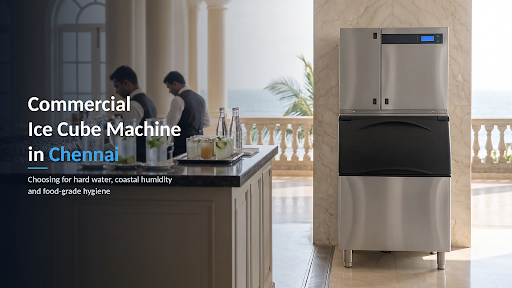
- A commercial kitchen in Chennai can face a combination of warm operating conditions, humid surroundings and varying water quality.
- Hard water can lead to mineral deposits inside an ice machine.
- A basic water report can include:.
- RO may be useful for some water conditions, but it should not be treated as a compulsory requirement for every Chennai installation.
- The temperature around the machine matters more than simply looking at Chennai’s outdoor temperature.
Choosing an ice cube machine in Chennai is not just about daily production capacity.
For restaurants, hotels, cafés and banquet operations, three site conditions matter:
- Water quality: Hardness and TDS can affect scaling and maintenance.
- Heat and humidity: The machine’s actual working environment can differ from its rated conditions.
- Hygiene: Ice used for drinks and food service must be produced, stored and handled hygienically.
The right machine should therefore match your ice demand, water condition, installation environment, ice type and service requirements.
Why Chennai Needs a Different Ice-Machine Check
A commercial kitchen in Chennai can face a combination of warm operating conditions, humid surroundings and varying water quality.
That doesn’t mean every location has the same problem.
A restaurant using municipal water may have different water characteristics from a site using borewell or treated water. Likewise, a machine installed in an air-conditioned service area may experience very different conditions from one placed beside cooking equipment.
So don’t select an ice cube machine in Chennai based only on the city’s climate.
Check the actual conditions at the machine location.
Test Your Water Before Choosing Treatment
Hard water can lead to mineral deposits inside an ice machine. Over time, scale can affect water flow, cleaning and maintenance.
But TDS and hardness are not the same thing.
Before buying an ice cube machine in Chennai, test the actual water that will enter the machine.
What to Check
A basic water report can include:
- TDS
- Total hardness
- pH
- Chloride
- Other parameters recommended by the machine supplier
The important point is that drinking-water reference values are not automatically the feed-water limits for an ice machine.
Share the water report with Ice Boy and ask for the acceptable limits for the exact model.
Don’t Automatically Choose RO
RO may be useful for some water conditions, but it should not be treated as a compulsory requirement for every Chennai installation.
The practical process is:
Water test → Share report with Ice Boy → Determine treatment → Install → Monitor and maintain
Depending on the water condition and machine requirements, treatment could involve filtration, softening, RO or another suitable arrangement.
For more information, see Ice Boy’s hard-water guide.
How Chennai Heat and Humidity Affect Machine Selection
The temperature around the machine matters more than simply looking at Chennai’s outdoor temperature.
Ice Boy’s published catalogue gives production ratings under specified air and water conditions. It also notes that production can be lower under warmer conditions.
That means you should not automatically assume that the published kg/day figure will be achieved under every installation condition.
Before choosing an ice cube machine in Chennai, check:
- Air temperature around the machine
- Inlet-water temperature
- Ventilation
- Clearance around the machine
- Distance from ovens and fryers
- Whether the room is enclosed or air-conditioned
Then ask Ice Boy:
What production should I expect from this exact model at my actual air and water temperatures?
If the machine location regularly becomes particularly hot, discuss the installation with Ice Boy before ordering.
Coastal Humidity and Machine Placement
Chennai’s coastal environment makes installation planning especially important.
Humidity itself should not be used as a reason to reject a machine. Instead, focus on practical installation conditions:
- Keep the machine away from direct water spray.
- Avoid placing it beside sinks where possible.
- Maintain the required airflow clearance.
- Keep the surrounding area clean and dry.
- Provide proper drainage.
- Allow enough space for cleaning and servicing.
- Avoid direct exposure to cooking heat.
The goal is simple:
Keep the machine ventilated, accessible and protected from unnecessary heat and water exposure.
Choose the Capacity From Your Busiest Day
Guest count alone cannot tell you how much ice you need.
A 300-seat restaurant and a 300-seat banquet venue may have very different ice consumption.
Instead, measure:
Peak-Day Ice Use
Record total ice consumed during your busiest realistic day.
Include:
- Drinking water
- Soft drinks
- Mocktails
- Cocktails
- Iced coffee and cold beverages
- Food preparation
- Buffet displays
- Beverage counters
- Event service
Peak-Window Ice Use
Then record how much ice is required during your busiest 2–4 hour period.
This is important because daily production and storage solve different problems.
A machine can produce enough ice over 24 hours but still leave you short during a busy dinner service if the storage bin is too small.
Simple Capacity Calculation
Start with:
Required daily capacity = Peak-day ice use × Demand buffer
For example, suppose a Chennai restaurant uses 80 kg of ice on its busiest day.
If you add a 20% planning buffer:
80 × 1.20 = 96 kg/day
A machine rated around 100 kg/day may appear suitable at its published rating.
But you still need to check the expected output under your actual air and water conditions.
That is why the final decision should not be:
“My demand is 96 kg, so I will simply buy a 100 kg machine.”
Instead:
Peak demand → Buffer → Site conditions → Expected production → Final model
Production and Storage Are Different
This is one of the most important things to check before buying an ice cube machine in Chennai.
Production = how much ice the machine can make over its production period.
Storage = how much ice the bin can hold at one time.
Suppose your restaurant needs 35 kg during a three-hour dinner rush.
If the machine cannot make enough ice during those three hours, you need sufficient storage to build the required stock before service begins.
So ask two separate questions:
- Can the machine produce enough ice every day?
- Can the storage bin hold enough ice for the busiest service window?
Restaurant Example
Suppose a restaurant records:
- Peak-day use: 80 kg
- Demand buffer: 20%
- Peak-window demand: 35 kg
Daily requirement:
80 × 1.20 = 96 kg/day
Now ask Ice Boy for the expected production of the selected machine under the actual site conditions.
For storage, if the machine can make only part of the 35 kg required during the three-hour rush, the remaining amount must already be available in the storage bin.
This prevents a common mistake:
Choosing the machine only from daily production and forgetting the busiest few hours.
Banquet-Hall Example
Suppose a Chennai banquet hall uses 180 kg of ice during a large event.
With a 20% planning buffer:
180 × 1.20 = 216 kg/day
A machine with a published capacity of 250 kg/day may appear to provide enough capacity.
But the banquet team should still check:
- Expected output at the actual installation temperature
- Inlet-water temperature
- Storage capacity
- Busiest three-hour demand
- Time available to build ice before the event
If those conditions do not provide enough margin, discuss a larger machine or multiple-machine setup with Ice Boy.
Which Ice Type Should You Choose?
Capacity is only one part of selecting an ice cube machine in Chennai.
Your application determines the ice type.
Bullet Ice
Bullet ice can suit:
- Bars
- Restaurants
- Cafés
- Hotels
- Beverage counters
See Ice Boy’s bullet ice machine range.
Dice Ice
Dice ice can suit:
- Restaurants
- Hotels
- Banquet halls
- Catering
- Quick-service operations
See Ice Boy’s dice ice machine range.
Choose based on:
- Beverage type
- Glass size
- Cooling requirement
- Presentation
- Daily demand
- Peak-hour demand
If you’re unsure, ask Ice Boy for an ice sample before finalizing the machine.
Ice Boy Machines to Compare
Use these models to build a shortlist, then ask Ice Boy to confirm expected output under your actual site conditions.
| Ice Boy model | Ice type | Published production | Storage | Power |
|---|---|---|---|---|
| BVM-210 | Bullet | 95 kg/day | 26 kg | 0.65 kW |
| SQ-220 | Dice | 100 kg/day | 30 kg | 760 W |
| SQ-275 | Dice | 125 kg/day | 30 kg | 0.75 kW |
| SQ-550 | Dice | 250 kg/day | 200 kg | 1.45 kW |
| SQ-1100 | Dice | 500 kg/day | 250 kg | 2.2 kW |
| BUZ-900 | Bullet | 400 kg/day | 220 kg | 2.20 kW |
| BUZ-1800 | Bullet | 800 kg/day | 220 kg | 4.40 kW |
For the latest specifications, use Ice Boy’s commercial ice machine range.
Don’t select a model simply because its production number is larger.
First match:
Demand + Ice type + Site conditions + Storage + Utilities + Service
Food-Grade Hygiene Matters
Ice that goes directly into drinks or comes into contact with food should be treated as a food-contact product.
That means hygiene cannot be an afterthought.
For an ice cube machine in Chennai, build cleaning and handling into your operating routine.
Check:
- Water quality
- Machine cleanliness
- Ice-bin cleanliness
- Scoop hygiene
- Hand-contact prevention
- Regular cleaning
- Filter maintenance
- Scale removal where required
- Safe ice storage
The machine should also be positioned so that cleaning and service can be carried out without difficulty.
Installation Checklist for Chennai
Before ordering, check:
- Water: Test the actual inlet water.
- Treatment: Confirm filtration/softening/RO requirements with Ice Boy.
- Power: Confirm voltage and electrical load.
- Drain: Provide a suitable drainage connection.
- Airflow: Leave the required clearance.
- Heat: Keep away from ovens and fryers.
- Humidity: Avoid unnecessary water spray and poorly drained areas.
- Space: Allow access for cleaning and servicing.
- Delivery: Check whether the machine can reach the installation area.
- Storage: Confirm the bin can support peak-hour demand.
Get These Details From Ice Boy Before Ordering
Ask Ice Boy to include the following in your quotation.
1. Expected Production
Give them:
- Peak-day demand
- Peak-hour demand
- Air temperature near the machine
- Inlet-water temperature
Ask for the expected production of the exact model under those conditions.
2. Storage Capacity
Confirm the actual bin capacity and whether it is sufficient for your busiest service window.
3. Water Treatment
Share your water report and ask what treatment the selected model requires.
4. Installation
Confirm:
- Power requirements
- Water connection
- Drain connection
- Required clearance
- Installation scope
- Space requirements
5. Warranty
Confirm:
- Warranty period
- Covered components
- Labour
- Service conditions
- Exclusions
- Registration requirements
Use Ice Boy’s warranty registration page.
6. Service
Ask:
- Who handles service in Chennai?
- How do you raise a service request?
- What is the expected response process?
- Are spare parts available?
- What maintenance is recommended?
See Ice Boy’s service support.
Frequently Asked Questions
Which ice cube machine is best for a Chennai restaurant?
There is no single best model. Start with peak-day and peak-hour demand, then match the required ice type, site conditions, storage and utilities.
Does Chennai’s hard water require an RO system?
Not automatically. Test the actual water entering the machine and ask Ice Boy what treatment is appropriate for the selected model.
Does humidity affect an ice machine?
The installation environment matters. Focus on ventilation, drainage, cleanliness, heat exposure and protection from unnecessary water spray.
Does Chennai’s heat reduce ice production?
The actual air and water temperatures can affect production. Ask Ice Boy for expected output under your site conditions rather than relying only on the published capacity.
How much storage do I need?
Calculate how much ice you need during your busiest service period and how much the machine can produce during that period. The difference helps determine the storage requirement.
Should I choose bullet or dice ice?
Choose based on your drinks, cooling requirement, presentation and business type. If needed, ask Ice Boy for samples before ordering.
What information should I send Ice Boy for a quotation?
Send your peak-day demand, peak-window demand, required ice type, air temperature near the machine, inlet-water temperature, water-test report, available power, drainage and installation-space details.
Then use the Ice Boy contact page to discuss the requirement.
Choose the Complete System, Not Just the Machine
The right ice cube machine in Chennai is not simply the model with the biggest production number.
It should match:
- Your peak demand
- Your busiest service window
- Your water condition
- Your installation temperature
- Your required ice type
- Your storage requirement
- Your hygiene routine
- Your service requirements
Measure demand first. Test the water. Check the installation conditions. Then ask Ice Boy to confirm production, storage, treatment, warranty and service before you order.
If you are planning an ice cube machine in Chennai for a restaurant, hotel, café or banquet hall, contact Ice Boy with your site and demand details for a capacity discussion and current quotation.