
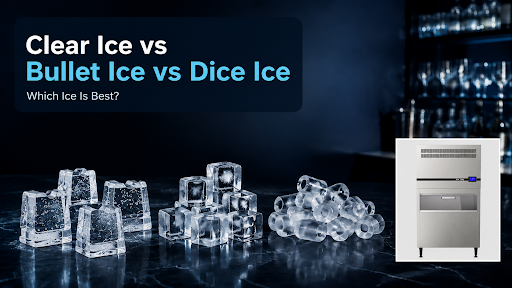
- The right ice depends on the drink and the experience you want to deliver.
- Cloudiness usually comes from air and material trapped while water freezes.
- Clear gourmet ice earns its place when the ice remains visible and supports the drink’s value.
- Dice ice is a solid square cube that looks familiar, clean and professional.
- Bullet ice is cylindrical and hollow.
There is no single best ice for every commercial venue. Clear gourmet ice is the strongest fit when presentation and controlled dilution matter. Dice ice gives restaurants, hotels and banquet operations a practical balance of appearance and everyday versatility. Bullet ice suits fast moving service where quick chilling and easy handling matter more than a luxury look.
The phrase clear ice vs bullet ice vs dice ice needs one clarification. “Clear” describes appearance, while bullet ice and dice ice describe shapes. Ice Boy also describes some bullet ice as clear. In this guide, clear gourmet ice means the solid Gourmet format made by Ice Boy’s ZX series. After that distinction is clear, the comparison becomes much easier.
Clear Ice vs Bullet Ice vs Dice Ice: The Main Differences
The right ice depends on the drink and the experience you want to deliver. A whisky served slowly has different needs from a cold coffee sold during a ten minute rush.
| Point to compare | Clear gourmet ice | Dice ice | Bullet ice |
| Physical form | Solid Gourmet format | Solid, six sided cube | Hollow cylindrical form |
| Main strength | Premium appearance and a substantial serve | Balanced presentation and versatility | Fast contact with the drink and practical handling |
| Common commercial fit | Luxury bars, five star hotels, premium restaurants | Hotels, restaurants, banquets and general beverage service | Cafés, QSR counters and high turnover drinks |
| Best starting question | Will guests notice and value the ice? | Do we need one professional cube for many drinks? | Is quick chilling and fast service the priority? |
| Main limitation | May be unnecessary when presentation adds little value | Not as visually distinctive as Gourmet ice | Hollow pieces may melt differently from solid ice of similar outside size |
| Ice Boy range | ZX series | SQ series | BVM and BUZ series |
This table is a decision guide, not a laboratory ranking. Ice Boy’s website states Gourmet ice melts 40% slower than bullet ice, though the same page elsewhere gives 30–40%. No test conditions are published, so treat it as a manufacturer claim and test samples in your own service conditions. Ask for physical samples and test them in your own glassware before committing to a machine.
Why Clarity and Shape Are Not the Same Thing
Cloudiness usually comes from air and material trapped while water freezes. A controlled process can reduce visible bubbles, but “clear” still is not a shape. Clear ice may be Gourmet, bullet, dice or another form.
Ice Boy’s own clarity comparison rates Gourmet ice at 98%, Bullet ice at 98% and Dice ice at 72%. This shows why clarity and shape should not be treated as the same thing: both Gourmet and Bullet can be described as highly clear while having completely different physical forms.
Clarity can improve a premium serve because the spirit, garnish and glass remain visible. Appearance alone does not prove that one piece will melt more slowly than another.
Melting depends on how heat reaches the ice. A compact piece exchanges heat differently from several small pieces or a hollow form. Mass, starting temperature, drink temperature and agitation also matter. This is why manufacturer melt-rate claims should be treated as product claims unless the test conditions are available.
Compare equal ice masses in the same drink and glass at fixed times. Do not judge performance from a photograph or clarity percentage.
When Clear Gourmet Ice Is the Better Choice
Clear gourmet ice earns its place when the ice remains visible and supports the drink’s value. It fits neat spirits, spirit forward cocktails, premium bottle service and signature serves.
Ice Boy positions its Gourmet ice machines for five star hotels, luxury bars and upscale establishments. Its ZX product pages describe a solid Gourmet format made using centrifugal technology. These are Ice Boy’s product claims; buyers should still request a sample, cube dimensions and a written production estimate for their site.
It may be unnecessary when drinks are consumed quickly, the ice is hidden in blended drinks or guests gain little from a premium presentation. It is also a poor fit when the selected machine cannot meet realistic demand or site requirements. Premium looking ice cannot fix a capacity shortage.
When Dice Ice Makes More Sense
Dice ice is a solid square cube that looks familiar, clean and professional. It works across water service, juices, soft drinks, highballs and many mixed drinks without making the ice itself the centre of attention.
That versatility makes Ice Boy’s SQ dice range relevant to hotels, restaurants and banquets using one format at several service points. Confirm final output for actual air and inlet water conditions.
Choose dice ice when the menu is broad and a consistent, solid cube matters more than a luxury Gourmet presentation. It is also a sensible middle route when bullet ice feels too functional but the commercial case for Gourmet ice is weak.
Ice Boy does not publish cube dimensions or mass consistently across its SQ pages. Request those details and a sample before standardising glassware or recipes.
When Bullet Ice Is the Practical Option
Bullet ice is cylindrical and hollow. The hollow centre increases the surface in contact with the drink, which can support quick heat transfer. Actual performance still depends on piece size, mass and serving conditions.
Ice Boy’s bullet ice range includes BVM and BUZ models. Bullet ice can suit iced coffee, tea, juices and soft drinks where quick chilling and easy scooping are useful.
Bullet ice is not automatically “low quality.” It can look clear and consistent, but it is hollow rather than solid. For slowly sipped or presentation led drinks, test it against dice and Gourmet samples.
Menus using whole and crushed ice involve a separate equipment decision, covered in the ice crusher vs ice cube machine guide.
Which Ice Type Fits Your Menu?
Start with the drink, not the machine brochure.
| Menu or service | Strong starting option | Why it may fit | What to test |
| Neat whisky or premium spirit | Clear gourmet ice | Distinctive, solid presentation | Fit in the glass, serving mass and dilution over the expected drinking time |
| Signature or spirit forward cocktail | Clear gourmet or dice ice | Presentation matters, but the recipe may need a specific cooling rate | Stirring time, final temperature and dilution |
| Highball, juice or soft drink | Dice or bullet ice | Both can support repeatable general beverage service | Ice to drink ratio and holding time |
| Cold coffee or iced tea | Bullet or dice ice | Quick chilling may matter more than a luxury look | Flavour after 10, 20 and 30 minutes |
| Banquet water and mixed beverage service | Dice or bullet ice | Volume and easy handling often lead the decision | Peak draw, bin recovery and transport between service points |
| Premium hotel bar | Clear gourmet ice for selected serves; dice for wider service | One ice type may not serve the complete menu well | Whether two formats justify the extra equipment and handling |
For an in venue test, weigh equal ice portions, use the same drink and glass, and record temperature, appearance and taste at fixed intervals. Repeat it during real service.
Ice Boy ZX Models for Premium Venues
Ice Boy publishes four ZX models covering 45 to 315 kg/day. The right starting point depends on the busiest realistic day, the amount required during the busiest hour and the production you can expect at your site.
| ZX model | Published production | Published storage | Published power | Published dimensions |
|---|---|---|---|---|
| ZX-100 | 45 kg/day | 30 kg | 0.37 kW | H810 × W600 × D600 mm |
| ZX-190 | 85 kg/day | 60 kg | 0.75 kW | H1100 × W730 × D730 mm |
| ZX-380 | 170 kg/day | 150 kg | 1.15 kW | H1600 × W700 × D840 mm |
| ZX-700 | 315 kg/day | 250 kg | 2.20 kW | H1750 × W990 × D970 mm |
These are product page values, not promised output at every installation. Confirm production for the site’s air and water temperatures. Enough kg/day also does not guarantee enough stored ice for a short rush.
Ice Boy also lists four ZXS models with slightly higher published outputs. Its website does not explain what “S” changes. Do not assume condenser type, cube size or another difference; request the current technical comparison if a ZXS model is quoted.
After choosing the ice format, calculate demand across every department sharing the machine. Keep the demand buffer separate from any site related output reduction, and compare daily production with the ice needed during the busiest service window.
Hygiene Matters More Than Clarity
Clear looking ice is not proof of safe ice. FSSAI’s licensing regulations state that ice and steam used in direct contact with food should be made from potable water and produced, handled and stored in a way that prevents contamination.
Test the inlet water and confirm treatment, cleaning chemicals and frequency. Self cleaning can help, but it does not replace safe scoops, clean bins, trained handling and manual checks.
Get These in Writing Before You Pay
Ask Ice Boy, or any commercial ice machine supplier, to include these details in the quotation or technical sheet:
- Exact ice shape, dimensions, average piece weight and a physical sample
- Expected kg/day at your room and inlet water temperatures
- Storage capacity and usable bin arrangement
- Water, drainage, ventilation and electrical requirements
- Water quality limits and the required filtration, RO or softening plan
- Cleaning steps, approved chemicals and recommended frequency
- Machine dimensions plus installation and service clearances
- Complete warranty period, exclusions and claim process
- Installation, commissioning and staff training inclusions
- Service contact, response process and spare parts availability
- For any ZXS quotation, the written technical difference from the equivalent ZX model
If the menu depends on a particular cube, make its sample and dimensions part of approval.
Which Ice Is Best for Your Business?
Choose clear gourmet ice when premium presentation and a substantial solid format support the value of the drink. Choose dice ice when you want a versatile professional cube across a wider menu. Choose bullet ice when quick chilling and fast moving service lead the decision.
That is the honest answer to clear ice vs bullet vs dice: the best option changes with the drink, service time, glassware, required volume and guest expectation.
For a premium venue considering the ZX series, share your menu, ice portion per drink, peak covers, event demand, site temperature, inlet water conditions, available space and utilities with Ice Boy. Request a model specific quotation and test a real Gourmet ice sample before selecting capacity.
Frequently Asked Questions
Is clear ice a separate shape?
No. Clear describes appearance, not shape. In this article, clear gourmet ice refers to Ice Boy’s solid Gourmet format. Bullet or dice ice may also appear clear depending on how it is produced.
Does clear ice always melt more slowly?
No. Clarity alone does not decide melting speed. Ice mass, size, surface area to volume ratio, hollowness, starting temperature, drink temperature and agitation all affect the result.
Which ice is best for whisky and premium cocktails?
Clear gourmet ice is a strong starting option when the ice remains visible and controlled dilution matters. Dice ice may also work well depending on cube size, glassware and recipe.
Which Ice Boy ZX model suits a premium bar?
Ice Boy publishes 45 kg/day for ZX-100, 85 kg/day for ZX-190, 170 kg/day for ZX-380 and 315 kg/day for ZX-700. Choose only after confirming peak demand, storage and expected output at the site.