
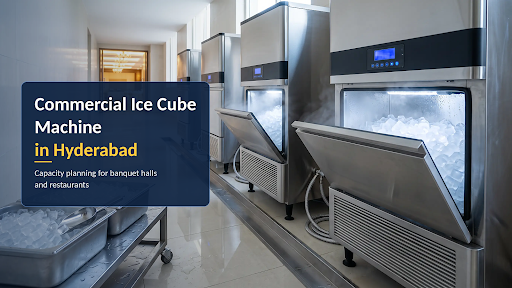
- Before comparing any Ice Boy model, find these two numbers.
- This is the total ice used during your busiest realistic day.
- This is the ice required during the busiest continuous service period, usually two to four hours.
- Ice Boy’s published catalogue states that daily production is based on 10°C air and 10°C water.
- Suppose a Hyderabad restaurant records 72 kg of ice use on its busiest day.
A restaurant can use most of its ice during dinner. A banquet hall may need a large quantity within two or three hours. Choosing an ice cube machine in Hyderabad only by its daily production number can therefore lead to a shortage during service.
Hyderabad’s summer conditions make this check even more important. A machine’s published output may be measured under specific air and water temperatures that differ from your kitchen or service area.
The right choice starts with your actual demand, actual room temperature and actual inlet-water temperature.
Why Guest Count Alone Is Not Enough
Guest count is a useful starting point, but it cannot give you the final machine size.
Two banquet halls serving 500 guests may use very different amounts of ice. One may serve only water and soft drinks. The other may have cocktails, welcome drinks, live counters and buffet displays.
Measure the ice your business actually uses.
For a new venue, estimate demand from:
- Expected covers
- Menu and drinks
- Buffet requirements
- Event type
- Expected service hours
- Similar business or event data
Then review the estimate after operations begin.
Start With Two Ice-Demand Numbers
Before comparing any Ice Boy model, find these two numbers.
1. Peak-Day Ice Use
This is the total ice used during your busiest realistic day.
Include ice used for:
- Water, soft drinks, mocktails and cocktails
- Food preparation and kitchen cooling
- Buffet or beverage displays
- Staff handling and normal waste
- Separate restaurant, room-service or event counters
Do not use a quiet weekday average if your real demand comes from Saturday dinner or wedding service.
2. Peak-Window Ice Use
This is the ice required during the busiest continuous service period, usually two to four hours.
A machine may produce enough ice over 24 hours but still leave you short during a three-hour rush if the storage bin is too small or was not filled before service.
This is why production capacity and storage capacity must be calculated separately.
Check the Temperature Behind the Capacity Number
Ice Boy’s published catalogue states that daily production is based on 10°C air and 10°C water. It also states that production at 32°C air and 25°C water is approximately 30% lower, with a recommended ambient-use range of 10°C to 38°C. These are Ice Boy’s published figures.
This matters in Hyderabad, where a machine may be installed in a hot kitchen, utility area or poorly ventilated service space.
The number printed beside a model should therefore be treated as a rated capacity, not an automatic promise of the same output at every site.
Before selecting an ice cube machine in Hyderabad, measure:
- Air temperature around the planned machine location
- Inlet-water temperature
- Available ventilation
- Distance from ovens, fryers and other heat sources
Then ask Ice Boy:
“What daily production should I expect from this exact model at my air and water temperatures?”
If your installation area can become particularly hot, ask Ice Boy to confirm whether the proposed machine and installation arrangement are suitable.
You can compare the available options on Ice Boy’s commercial ice machine range.
Calculate the Production Capacity You Need
Use this planning formula:
Required published capacity = Peak-day ice use × Demand buffer ÷ Expected site-output factor
Keep the two adjustments separate.
The demand buffer covers expected changes in orders, bookings or menu use. You choose it based on your business.
The site-output factor accounts for the difference between the machine’s published rating and the expected output under your actual operating conditions.
For example, if Ice Boy confirms that expected site output is 70% of the published rating, use 0.70.
If output falls by 30%, choosing a machine rated only 30% above your demand does not fully cover the reduction. Dividing by 0.70 gives about 1.43 times the base demand before adding any demand buffer.
Restaurant Example
Suppose a Hyderabad restaurant records 72 kg of ice use on its busiest day.
It chooses a 10% demand buffer for this planning example.
72 × 1.10 = 79.2 kg/day
At published rating conditions, the Ice Boy BVM-210 at 95 kg/day or SQ-220 at 100 kg/day may look suitable, depending on the required ice shape.
Now assume Ice Boy confirms that the selected site conditions give a 0.70 output factor:
72 × 1.10 ÷ 0.70 = 113.14 kg/day
The 95 kg and 100 kg models would then be too small for this example.
The SQ-275 at 125 kg/day becomes the next verified dice-ice starting point. Ice Boy currently lists the SQ-275 at 125 kg/day with 30 kg storage and 0.75 kW power.
The lesson is simple:
Calculate with expected site output, not only the number in the model name.
Calculate Storage for the Busiest Hours
Storage does not increase production. It holds ice made before the rush.
Use this starting formula:
Starting ice needed before the peak = Peak-window demand − Expected production during the window
For an initial estimate:
Expected production during the window = Published daily capacity × Site-output factor ÷ 24 × Peak hours
This calculation assumes production is spread evenly through the day. Actual ice-making cycles can vary, so ask Ice Boy to confirm the final figure.
Restaurant Storage Example
Assume the restaurant needs 30 kg during a three-hour dinner peak.
If the SQ-275 produces at a confirmed 0.70 site factor:
125 × 0.70 ÷ 24 × 3 = 10.94 kg
So approximately 10.94 kg could be produced during those three hours.
30 − 10.94 = 19.06 kg
Around 19 kg of ice would therefore need to be available before the peak.
The SQ-275 has a published 30 kg storage capacity. It fits this starting calculation on paper, provided the bin is allowed to fill before service and the final site-output estimate is correct.
Banquet-Hall Capacity Example
Suppose a Hyderabad banquet venue records 185 kg of ice use on a busy event day.
It chooses a 10% demand buffer.
185 × 1.10 = 203.5 kg/day
At published rating conditions, the Ice Boy SQ-550 at 250 kg/day appears to cover this amount. Ice Boy’s catalogue lists the SQ-550 at 250 kg/day with 200 kg storage and 1.45 kW power.
But if Ice Boy confirms a 0.70 output factor for the actual site:
185 × 1.10 ÷ 0.70 = 290.71 kg/day
One SQ-550 would not meet that planning target.
The venue may need to consider:
- A larger machine
- The SQ-1100
- A multi-machine setup
- A different production/storage arrangement recommended by Ice Boy
Now Check Storage
Assume the banquet needs 120 kg during its busiest three hours.
If an SQ-1100 is expected to deliver 70% of its published output:
500 × 0.70 ÷ 24 × 3 = 43.75 kg
Approximately 43.75 kg could be produced during the peak period.
120 − 43.75 = 76.25 kg
Around 76 kg of ice would need to be available before the peak.
The SQ-1100 has a published 250 kg storage capacity, which is above this starting requirement.
However, the operating team still needs enough time to build the required stock before guests arrive.
Ice Boy Models to Compare
The following figures are based on Ice Boy’s published model specifications.
Use them to build a shortlist, then ask Ice Boy to confirm expected output for your actual site.
| Ice Boy Model | Ice Type | Published Production | Storage | Published Power |
|---|---|---|---|---|
| BVM-210 | Bullet | 95 kg/day | 26 kg | 0.65 kW |
| SQ-220 | Dice | 100 kg/day | 30 kg | 760 W |
| SQ-275 | Dice | 125 kg/day | 30 kg | 0.75 kW |
| SQ-550 | Dice | 250 kg/day | 200 kg | 1.45 kW |
| SQ-1100 | Dice | 500 kg/day | 250 kg | 2.2 kW |
| BUZ-1800 | Bullet | 800 kg/day | 220 kg | 4.40 kW |
For detailed specifications, see Ice Boy’s bullet ice machines and dice ice machines.
Do not select only by kg/day.
First decide:
- What ice shape does the business need?
- How much ice is needed per day?
- How much is needed during the busiest hours?
- What storage capacity is required?
- What is the expected output at the actual site?
- Does the available space support the machine?
- Is the electrical supply adequate?
- Can the water and drainage connections support the machine?
Ask for ice samples if drink appearance, melt rate or glass size matters.
When One Machine May Not Be Enough
A large banquet operation may need more capacity than one machine can provide under its expected site conditions.
Two machines can provide flexibility.
For example:
- One machine can cover normal demand.
- The second can support large events.
- One machine can remain available if the other requires service.
But two machines also require more:
- Floor space
- Power
- Water
- Drainage
- Cleaning
- Maintenance
Ask Ice Boy to compare one larger machine versus a multi-machine setup using the same demand record and site conditions.
Check Water and Installation Before Ordering
Water quality should be checked before installing a commercial ice machine.
Test the water entering the machine instead of assuming every Hyderabad site has the same water quality.
Share the water report with Ice Boy and ask whether the site needs:
- Filtration
- Water softening
- RO
- Another treatment method
The recommendation should be based on the actual water test and the machine’s requirements.
Also confirm:
- Correct electrical supply and protection
- Water pressure and inlet connection
- Drain type and drain position
- Airflow clearance around the machine
- Space to open panels and clean the unit
- Floor strength
- Delivery access
- Installation space
For water-related concerns, you can also review Ice Boy’s hard-water guide.
Get These in Writing Before You Pay
Ask Ice Boy to include these points in the written quotation.
Expected Output at Your Site
Give Ice Boy the hottest air temperature near the machine and the inlet-water temperature.
Ask for the expected production of the exact model under those conditions.
Production and Storage
Confirm both figures separately.
A machine may have sufficient daily production but insufficient storage for your busiest service window.
Water Treatment
State the required filtration or treatment based on your inlet-water report.
Warranty
Confirm:
- Warranty period
- Covered parts
- Labour coverage
- Travel/service conditions
- Exclusions
- Registration requirements
Ice Boy provides a warranty registration page. Confirm the exact warranty terms for your selected model in the quotation.
Hyderabad Service
Confirm:
- Who to contact
- Expected response process
- Technician availability
- Spare-parts support
- Service coverage
Ice Boy states that it provides pan-India service support.
Installation Scope
List what is included and what the buyer must arrange.
Also record the final:
- Electrical requirements
- Water requirements
- Drain requirements
- Machine dimensions
- Installation space
Final Model and Price
Record the exact:
- Model
- Ice type
- Production capacity
- Storage capacity
- Taxes
- Freight
- Installation charges
- Payment terms
This protects both sides. The buyer knows what is being supplied, and Ice Boy receives clearer site information before recommending a machine.
Frequently Asked Questions
Which ice cube machine is best for a Hyderabad restaurant?
There is no single best model for every restaurant. Measure peak-day and peak-window use, choose the required ice shape and ask Ice Boy for expected output at your actual room and water temperatures.
How much extra capacity should I keep?
Choose a demand buffer based on booking changes, seasonal sales and expected growth. Keep this separate from any heat-related production loss.
Is the storage number the same as daily production?
No.
Production is the amount the machine can make over its stated production period.
Storage is the amount of ice the bin can hold at one time.
Does a Hyderabad kitchen’s temperature affect ice production?
Yes. Warmer air and water can affect machine performance and output.
Ice Boy’s catalogue itself shows lower production under warmer air and water conditions, which is why the site temperature should be considered before choosing a machine.
Should I buy one large machine or two smaller machines?
It depends on peak demand, space, utilities and backup requirements.
Ask Ice Boy to compare both arrangements using your expected site output, storage requirements and installation conditions.
What should I send Ice Boy before asking for a quote?
Send:
- Peak-day ice use
- Busiest-window demand
- Required ice type
- Hottest machine-room temperature
- Inlet-water temperature
- Water-test report
- Available power
- Drain details
- Installation-space measurements
You can then use the Ice Boy contact page to discuss the requirement.
Choose From Your Real Peak, Not a Guess
The right ice cube machine in Hyderabad is not simply the model with the largest production number.
It should be a system that can:
- Produce enough ice under your site conditions
- Store enough ice for the busiest service period
- Match your required ice type
- Handle your water conditions
- Fit your available space and utilities
- Have suitable service and support
Measure the demand first. Check heat and water next. Then ask Ice Boy to confirm production, storage, water treatment, warranty and service in writing.
If you are planning an ice cube machine in Hyderabad for a restaurant, hotel or banquet hall, contact Ice Boy with your demand and site details to discuss the appropriate machine and get a current quotation.