
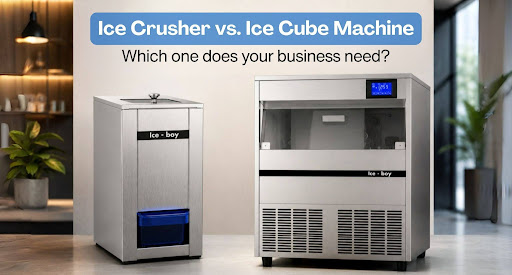
- Before comparing features and costs, it is important to understand what each machine actually does.
- An ice cube machine is the primary equipment responsible for producing ice.
- Although different manufacturers use different technologies, the basic process remains similar.
- An ice crusher machine performs a completely different task.
- The process is straightforward.
If you’re planning to buy commercial ice equipment for your business, one question often comes up: Should you buy an ice cube machine or an ice crusher machine?
At first glance, the two machines appear similar because both are associated with ice. However, they perform completely different functions. One creates ice from water, while the other processes existing ice into smaller pieces.
Surprisingly, many first-time buyers assume an ice crusher can produce ice on its own. This misunderstanding often leads to purchasing the wrong equipment, operational delays, and additional investment later.
Whether you run a café, cocktail bar, restaurant, hotel, smoothie outlet, catering business, hospital, or laboratory, understanding the difference between these machines is essential before making a purchase.
In this guide, we’ll compare ice crusher vs ice cube machine in detail, explain where each machine fits, which businesses need one or both, and how to choose the right setup for long-term operations.
Understanding the Basics
Before comparing features and costs, it is important to understand what each machine actually does.
Although both are part of commercial ice handling systems, they solve two completely different operational problems.
What Is an Ice Cube Machine?
An ice cube machine is the primary equipment responsible for producing ice.
The machine takes a continuous supply of water, freezes it using a refrigeration system, and automatically releases finished ice into a storage bin. Once the storage bin reaches capacity, production pauses until more ice is used.
Unlike domestic freezers, commercial ice machines are designed for continuous production. Depending on the model, they can produce anywhere from 20 kilograms to more than 800 kilograms of ice per day, making them suitable for everything from small cafés to industrial ice production facilities.
Modern commercial ice machines also offer different ice formats based on business requirements, including:
- Bullet ice
- Dice ice
- Gourmet ice
- Crescent ice (in certain models)
Each ice type is engineered for different applications. For example, dense gourmet ice is preferred in premium bars because it melts slowly, while bullet ice is widely used in cafés where beverages need to be cooled quickly during busy service hours.
A commercial ice cube machine is therefore the starting point of the entire ice production process. Without it, there is simply no ice available for beverages, food service, storage, or processing.
How Does an Ice Cube Machine Work?
Although different manufacturers use different technologies, the basic process remains similar.
The machine:
- Draws water from the supply line.
- Filters and circulates water over the evaporator.
- Freezes water into the selected ice shape.
- Releases finished ice automatically into the storage bin.
- Repeats the cycle continuously.
The quality of the freezing system has a major impact on:
- Ice clarity
- Ice density
- Melt rate
- Production speed
- Machine efficiency
This is why two machines producing the same quantity of ice can deliver completely different ice quality.
Advanced commercial systems, such as those using patented evaporator technology, create denser and more consistent ice while reducing maintenance requirements.
What Is an Ice Crusher Machine?
An ice crusher machine performs a completely different task. Instead of producing ice, it breaks existing ice cubes into smaller pieces or crushed ice.
It cannot freeze water. It cannot create new ice. It only processes ice that has already been produced by an ice maker or purchased externally.
This distinction is one of the biggest misconceptions among first-time buyers.
Many businesses purchase a crusher expecting it to function like an ice maker, only to realise that they still need a separate machine to produce ice.
How Does an Ice Crusher Work?
The process is straightforward. Ice cubes are fed into the crusher manually or through a hopper.
Inside the machine:
- Rotating blades or crushing mechanisms break the cubes.
- The crushed ice is discharged immediately.
- The ice is then ready for beverages, therapy, displays, or food applications.
Because no freezing process is involved, crushers:
- Produce crushed ice instantly
- Occupy less space
- Consume less electricity than ice makers
- Require no water connection
However, they are entirely dependent on having a steady supply of cube ice.
Related Read:
Ice Crusher vs Ice Cube Machine: Key Differences
Although both machines are frequently purchased together, they serve very different purposes.
| Feature | Ice Cube Machine | Ice Crusher Machine |
| Primary Function | Produces fresh ice from water | Crushes existing ice cubes |
| Makes Ice | ✅ Yes | ❌ No |
| Requires Water Connection | ✅ Yes | ❌ No |
| Refrigeration System | ✅ Yes | ❌ No |
| Crushes Ice | ❌ No | ✅ Yes |
| Continuous Production | ✅ Yes | Depends on available cubes |
| Main Users | Cafés, hotels, restaurants, hospitals | Bars, smoothie shops, seafood counters, therapy applications |
While this table explains the technical differences, the more important distinction lies in how each machine contributes to business operations.
An ice cube machine ensures that your business always has a reliable supply of fresh ice. Without it, beverage service, food preservation, and daily operations quickly come to a halt.
An ice crusher, on the other hand, adds versatility. It allows businesses to convert cube ice into crushed ice whenever required without needing to purchase or store multiple ice types.
Rather than competing products, these machines complement each other.
When Do You Need an Ice Cube Machine?
Any business that uses ice regularly needs an ice cube machine as its primary source of production. The exact capacity depends on daily demand, but the machine itself forms the foundation of the operation.
Cafés and Coffee Shops
Modern cafés serve far more than hot coffee. Menus now include:
- Iced lattes
- Cold brew
- Frappes
- Refreshers
- Mocktails
- Smoothies
All of these beverages rely on a steady supply of quality ice.
Without an ice cube machine, cafés often struggle during peak hours, leading to slower service or dependence on externally purchased ice.
For cafés, bullet ice machines are often preferred because they produce ice quickly and support fast beverage preparation.
Restaurants
Restaurants use ice in multiple departments simultaneously.
Ice may be required for:
- Beverage stations
- Kitchen preparation
- Buffet counters
- Food preservation
- Seafood display
Since demand fluctuates throughout the day, restaurants require machines capable of maintaining consistent production rather than producing ice in small batches.
Hotels and Resorts
Hotels operate almost continuously. Ice is consumed across:
- Guest rooms
- Restaurants
- Banquets
- Bars
- Room service
- Event catering
This makes production reliability more important than maximum output alone.
Hotels generally invest in commercial-grade machines that can operate for long hours while maintaining consistent ice quality.
Related Read: Best Ice Cube Making Machines for Hotels and Bars
Hospitals and Healthcare Facilities
Hospitals rely on ice for much more than beverages. It is commonly used for:
- Patient hydration
- Medical storage
- Cold therapy
- Laboratory support
In these environments, hygiene, consistency, and reliability become just as important as production capacity.
Machines must be easy to clean and capable of producing food-grade ice continuously.
Related Read: Ice Machine for Hospital: Types, Prices & Buying Guide
Packaged Ice Businesses
For businesses producing packaged drinking ice, the ice machine is the heart of the entire operation. Every aspect of the business depends on consistent production, including:
- Packaging
- Inventory management
- Delivery schedules
- Customer satisfaction
These businesses generally invest in larger commercial or industrial ice machines capable of producing several hundred kilograms of ice every day.
When Do You Need an Ice Crusher Machine?
Unlike an ice cube machine, an ice crusher is required only when your business regularly uses crushed ice rather than whole cubes.
Many businesses can operate successfully without one, while others would struggle to deliver their core products without crushed ice.
Cocktail Bars
Cocktail bars are among the biggest users of crushed ice. Drinks such as:
- Mojitos
- Mint Juleps
- Frozen Margaritas
- Tiki cocktails
all rely on crushed ice for both presentation and temperature control.
Using whole cubes changes the drinking experience, texture, and dilution profile.
For bars, an ice crusher is therefore an essential companion to the ice maker rather than an optional accessory.
Smoothie and Juice Shops
Blended beverages require crushed ice to create the correct consistency. Large cubes place additional stress on blenders and often produce uneven textures.
A crusher allows businesses to prepare uniform crushed ice that blends more efficiently while improving drink consistency.
Seafood and Food Displays
Seafood counters use crushed ice because it surrounds products evenly.
Unlike cubes, crushed ice fills gaps and provides better surface contact, helping maintain consistent cooling throughout the display.
This makes it ideal for fish markets, seafood restaurants, and buffet counters.
Cold Therapy and Healthcare Applications
Crushed ice is widely used in:
- Physiotherapy
- Sports recovery
- Hospitals
- Diagnostic facilities
It conforms to the body more effectively than cubes, making it suitable for injury treatment and cold compresses.
Businesses That Need Both Machines
One of the biggest misconceptions buyers have is believing they need to choose either an ice cube machine or an ice crusher. In reality, many commercial businesses benefit from having both because each machine performs a completely different function.
An ice cube machine ensures a continuous supply of fresh ice, while the crusher converts a portion of that ice into crushed ice whenever required. This combination gives businesses flexibility without the need to source different ice types from multiple suppliers.
Let’s look at industries where investing in both machines makes operational and financial sense.
Cocktail Bars and Lounges
Cocktail bars rarely rely on a single type of ice.
A premium whisky may be served with a dense gourmet cube that melts slowly, while a mojito or frozen cocktail requires finely crushed ice to achieve the correct texture and temperature.
Without an ice crusher, bartenders either have to manually crush ice, which slows service and creates inconsistency, or purchase crushed ice separately, which increases costs and creates storage challenges.
A combination setup allows bars to:
- Produce fresh cube ice throughout the day.
- Prepare crushed ice instantly during peak hours.
- Maintain consistency across cocktail recipes.
- Improve service speed during busy evenings.
For bars where beverage quality directly influences customer experience, having both machines quickly becomes an operational necessity rather than a luxury.
Cafés and Coffee Shops
Modern cafés serve far more than iced coffee. Their beverage menus often include:
- Frappes
- Smoothies
- Cold brews
- Refreshers
- Frozen beverages
- Specialty seasonal drinks
Some drinks require bullet or cube ice, while others blend better with crushed ice.
For example:
- An iced latte performs well with bullet ice because it cools quickly without excessive dilution.
- A frappe or frozen coffee requires crushed ice to achieve the desired texture.
Instead of purchasing separate ice products, cafés can produce cubes continuously and crush only the quantity required throughout the day.
This reduces waste while improving consistency.
Hotels and Resorts
Hotels have one of the most diverse ice requirements of any hospitality business.
Different departments use ice differently. Restaurants need cubes. Bars need crushed ice. Room service requires packaged ice.
Banquets may need hundreds of kilograms for beverage stations. Kitchen operations may use ice for seafood displays or ingredient preservation.
Rather than installing separate production systems for each department, many hotels operate a centralized ice production setup combined with crushers where necessary.
This simplifies operations while improving inventory management across departments.
Catering Businesses
Catering companies rarely have predictable demand. One day they may serve a corporate meeting for fifty people.
The next day they may cater a wedding with over one thousand guests. Their ice requirements also vary significantly depending on:
- Beverage menu
- Outdoor temperature
- Event duration
- Number of service stations
Having both machines allows catering businesses to remain flexible.
Cube ice can be used for beverage cooling and storage, while crushed ice supports cocktail stations, buffet displays, and seafood presentations.
This flexibility allows caterers to adapt to different event formats without depending on external suppliers.
Healthcare and Laboratory Facilities
Hospitals and laboratories often require both forms of ice.
Cube ice is commonly used for:
- Patient hydration
- Beverage service
- General cooling
- Sample storage
Crushed ice is preferred for:
- Cold therapy
- Ice packs
- Sample transport
- Laboratory cooling applications
A cube machine paired with a crusher enables healthcare facilities to produce multiple ice formats while maintaining consistent hygiene standards.
Cost Comparison
Although these machines are often discussed together, they represent very different investments.
An ice cube machine contains a complete refrigeration system responsible for producing ice from water. It includes components such as compressors, condensers, evaporators, water circulation systems, and automatic controls.
As a result, its cost reflects the complexity of the technology involved.
Ice crusher machines, on the other hand, do not produce ice. Their primary function is to process already-produced cubes into crushed ice.
Because they contain fewer refrigeration components, they are generally more affordable and simpler to install.
Instead of asking which machine is cheaper, businesses should ask a more important question:
Which machine solves the operational challenge I have today?
For some businesses, only an ice maker is necessary.
For others, especially beverage-focused businesses, adding a crusher improves efficiency and expands menu possibilities without requiring another ice production system.
Which Machine Is Better?
This question comes up frequently, but it is based on the wrong comparison. An ice crusher and an ice cube machine are not competing products.
They perform completely different jobs. An ice cube machine creates ice from water.
An ice crusher transforms that ice into a different format. Comparing the two is similar to comparing a coffee machine with a coffee grinder.
One prepares the base ingredient. The other modifies it for a particular application.
The better question is:
Which machine does your business need first?
If your business currently has no reliable source of ice, an ice cube machine should always be the first investment.
Once production is established, a crusher becomes valuable if your menu or operations regularly require crushed ice.
Businesses serving cocktails, smoothies, frozen beverages, seafood displays, or therapy applications usually benefit from having both.
Common Buying Mistakes
Many buyers focus on the purchase itself instead of thinking about how the equipment will fit into daily operations.
Here are some of the most common mistakes businesses make.
Buying an Ice Crusher Expecting It to Produce Ice
This is easily the most common misunderstanding.
Some first-time buyers assume that feeding water into an ice crusher will somehow produce crushed ice. An ice crusher has no refrigeration system. It cannot freeze water.
Without a separate ice maker, the crusher cannot operate. Understanding this distinction before purchasing prevents unnecessary investment and operational delays.
Underestimating Crushed Ice Demand
Many businesses purchase only an ice cube machine because cubes satisfy their immediate requirements.
Over time, menus evolve. Smoothies are introduced. Frozen beverages have become popular.
Cocktail menus expand. Recovery services are added. Suddenly, the demand for crushed ice increases.
Planning for future menu growth often makes purchasing a crusher a worthwhile investment rather than waiting until operational limitations appear.
Choosing Residential Equipment for Commercial Operations
Residential machines are designed for occasional household use. Commercial businesses often require continuous production throughout the day.
Using home equipment in cafés, bars, or restaurants typically results in:
- Lower production capacity
- Frequent breakdowns
- Longer recovery times
- Higher replacement costs
Commercial equipment may involve higher initial investment, but it is engineered for continuous operation and significantly longer service life.
Ignoring Maintenance Requirements
Ice machines are food equipment. Regular cleaning, filter replacement, and preventive servicing are essential.
Businesses that ignore maintenance often experience:
- Cloudy ice
- Reduced production
- Hygiene issues
- Increased electricity consumption
- Unexpected downtime
Machines designed with easy-clean systems and accessible service components reduce maintenance effort while improving long-term reliability.
Planning Only for Current Demand
Many businesses buy equipment based solely on today’s requirements.
However, beverage menus, customer traffic, and business scale often change within a few years.
Purchasing a machine with slightly higher capacity than current demand provides room for growth without requiring immediate equipment replacement.
Recommended Setup by Business Type
| Business Type | Ice Cube Machine | Ice Crusher | Recommendation |
| Café | ✓ | Optional | Bullet ice machine is usually sufficient initially. Add a crusher if frozen beverages become part of the menu. |
| Smoothie Shop | ✓ | ✓ | Both machines are recommended. Continuous cube production combined with instant crushing supports fast service. |
| Cocktail Bar | ✓ | ✓ | Essential combination. Different cocktails require both whole cubes and crushed ice. |
| Restaurant | ✓ | Optional | Cube machines meet most needs. Crushers become valuable for specialty beverages or seafood service. |
| Hotel | ✓ | ✓ | Recommended due to diverse departmental requirements across restaurants, bars, banquets, and room service. |
| Hospital | ✓ | Optional | Cube machines handle general operations, while crushers support therapy and recovery applications. |
| Laboratory | ✓ | Optional | Cube machines paired with crushers provide flexibility for cooling and sample handling. |
Final Thoughts
The debate around ice crusher vs ice cube machine often assumes that one machine is a replacement for the other. In reality, they are complementary pieces of equipment designed to solve different operational challenges.
An ice cube machine is responsible for producing fresh, hygienic ice continuously. Without it, businesses have no dependable source of ice for beverages, food service, healthcare, or industrial applications.
An ice crusher builds on that foundation by converting cube ice into crushed ice for applications where texture, cooling efficiency, or presentation matter more than cube form.
For many cafés and restaurants, an ice maker alone may be enough during the early stages of business. As menus expand and operations become more sophisticated, adding an ice crusher often improves workflow, reduces manual effort, and enhances customer experience.
The best investment is not determined by which machine costs less or appears more versatile. It is determined by understanding how your business uses ice every day and selecting equipment that supports those requirements reliably for years to come.
With commercial ice cube machines, dedicated ice crushers, and scalable production capacities, Ice-boy offers businesses the flexibility to build an ice system that grows alongside their operations.
FAQs
What is the difference between an ice crusher and an ice cube machine?
An ice cube machine produces fresh ice from water, while an ice crusher only crushes existing ice cubes into smaller pieces. An ice crusher cannot make ice on its own.
Can an ice crusher make ice?
No. An ice crusher is designed only to process already-made ice. You need an ice cube machine or another source of ice before using a crusher.
Do cafés need an ice crusher?
Not always. Cafés serving iced coffee and cold beverages can operate with an ice cube machine, but cafés offering frappes, frozen drinks, or smoothies often benefit from adding an ice crusher.
Is crushed ice better than ice cubes?
Neither is better overall. Crushed ice is ideal for smoothies, cocktails, and cold therapy, while ice cubes are preferred for beverages that require slower dilution and longer cooling.
Should I buy both an ice maker and an ice crusher?
If your business regularly uses both cube ice and crushed ice, investing in both machines is usually the most practical solution. It provides greater flexibility and supports a wider range of beverages and applications.