
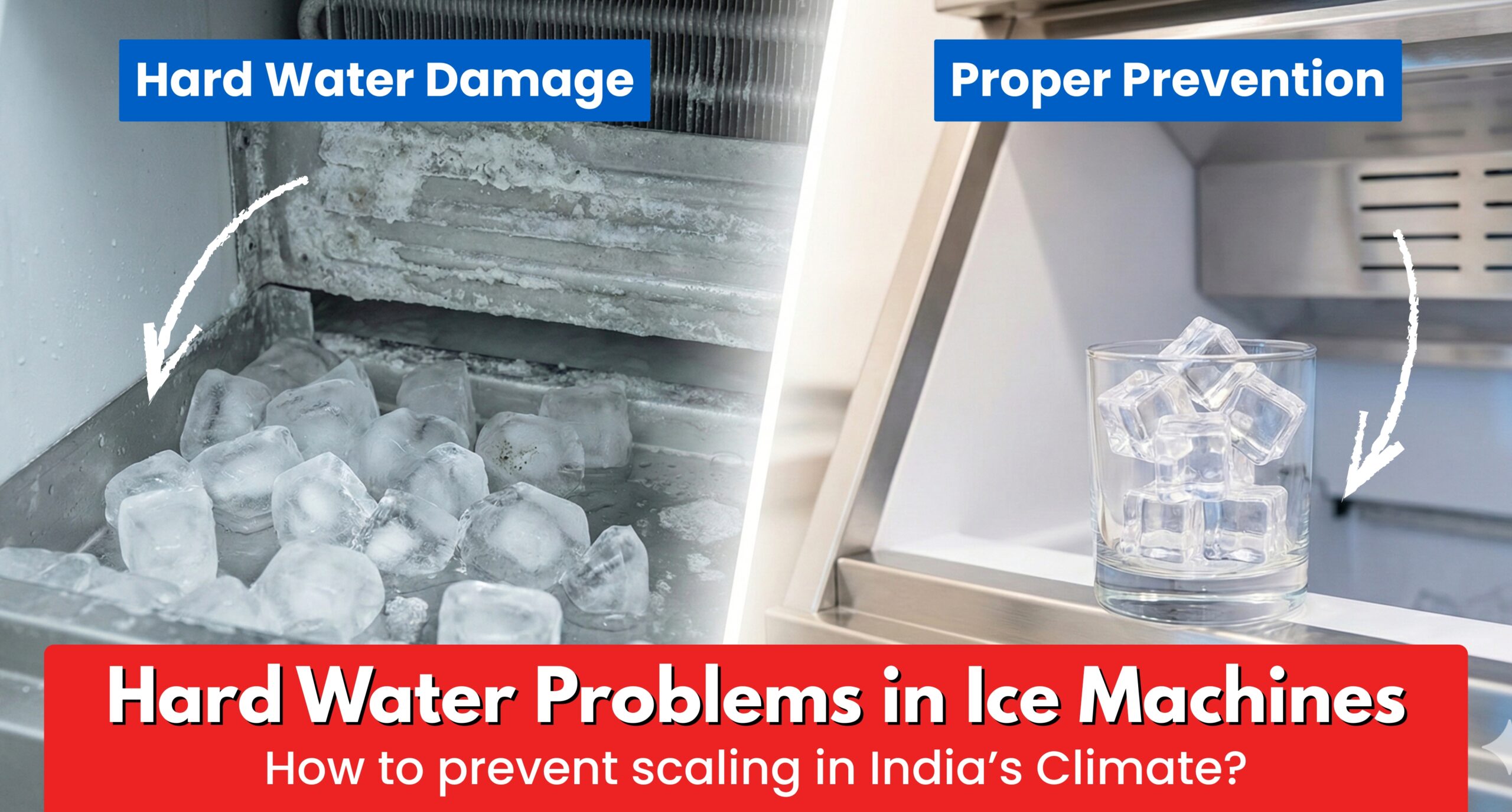
- Ice machines are essential across India’s hotels, restaurants, cafés, cloud kitchens, hospitals, and clinics.
- Hard water contains high concentrations of dissolved minerals, primarily:.
- When water freezes or heats up, dissolved minerals separate and crystallize.
- Ice machines rely on precise temperature control.
- Many Indian businesses rely on groundwater, which:.
Find out why mineral-heavy water damages commercial ice machines and discover proven solutions designed for India’s climate and water conditions.
Quick Summary
- Hard water is one of the leading reasons ice machines underperform or fail in India.
- Mineral buildup causes cloudy ice, slower production, and higher power consumption.
- Proper filtration, regular descaling, and correct installation significantly extend machine life.
- Ice-boy machines are engineered specifically to handle India’s hard water and high ambient temperatures.
Table of Contents
- Introduction
- Understanding Hard Water Problems in Ice Machines
- Why Scaling Is Worse in India’s Climate
- How Hard Water Affects Ice Machines
- How to Prevent Scaling in India’s Climate
- How Ice-boy Machines Reduce Hard Water Problems
- Conclusion
- Frequently Asked Questions
Introduction
Ice machines are essential across India’s hotels, restaurants, cafés, cloud kitchens, hospitals, and clinics. They support food safety, beverage quality, medical procedures, and efficient service operations.
Despite their importance, ice machines in India face a persistent challenge: hard water. Due to India’s geological structure and climate, most water sources contain high levels of dissolved minerals. Over time, these minerals form scales inside ice machines, reducing efficiency and damaging critical components.
Important: In India’s hot climate where machines operate for extended hours scale buildup accelerates. Businesses that ignore hard water issues often experience frequent breakdowns, rising electricity bills, poor ice quality, and premature equipment failure.
Understanding the impact of hard water is the first step toward protecting your investment.
Understanding Hard Water Problems in Ice Machines
What Is Hard Water?
Hard water contains high concentrations of dissolved minerals, primarily:
- Calcium carbonate
- Magnesium sulfate
- Silicates
- Trace metals
While these minerals are safe for human consumption, they are extremely harmful to commercial equipment.
How Does Hard Water Produce Scale?
When water freezes or heats up, dissolved minerals separate and crystallize. Inside ice machines, these deposits accumulate on:
- Evaporator plates
- Refrigeration coils
- Water distribution pipes
- Nozzles and sensors
This hardened layer acts as insulation, reducing heat transfer efficiency.
Why Ice Machines Are Highly Sensitive
Ice machines rely on precise temperature control. Even a thin layer of scale can cause:
- Longer freezing cycles
- Poor cube formation
- Increased compressor load
In practical terms, the machine works harder while producing less ice leading to inefficiency and wear.
Why Scaling Is Worse in India’s Climate
1. Dependence on Borewell and Groundwater
Many Indian businesses rely on groundwater, which:
- Passes through mineral-rich rock layers
- Contains high calcium and magnesium levels
- Often exceeds 300 ppm TDS (global ideal is below 150 ppm)
This alone accelerates scale formation.
2. High Ambient Temperatures
With summer temperatures frequently exceeding 35°C:
- Ice machines run longer per cycle
- Heat dissipation becomes more difficult
- Mineral deposits form faster
The hotter the environment, the quicker scaling occurs.
3. Monsoon Variability
During monsoons:
- Water composition changes suddenly
- Sediment and mineral content spike
- Machines face unpredictable operating stress
4. Lack of Water Pre-treatment
Many kitchens and facilities skip:
- Filtration systems
- Water softeners
- Pre-treatment units
As a result, ice machines are exposed directly to untreated hard water.
In India’s conditions, preventing scaling is not optional it is essential.
How Hard Water Affects Ice Machines
Typical Impact Levels:
- 20–40% reduction in ice production
- 15–25% increase in power consumption
- Every 30 days recommended descaling in hard water regions
1. Reduced Ice Production
Scale blocks heat transfer on cooling surfaces, slowing ice formation and reducing daily output especially problematic during peak demand.
2. Poor Ice Quality
Hard water causes:
- Cloudy or opaque ice cubes
- Brittle edges
- Ice breakage during dispensing
Customers often associate poor ice quality with low hygiene standards.
3. Higher Energy Consumption
Scale buildup forces:
- Longer compressor run times
- Increased water cycling
- Temperature instability
Electricity costs can rise by 15–25%.
4. Frequent Breakdowns
Mineral deposits damage critical components such as:
- Water pumps
- Solenoid valves
- Float switches
- Ice thickness sensors
This results in repeated service calls and operational downtime.
5. Shortened Machine Lifespan
Unchecked scaling accelerates corrosion, damages heat exchangers, and leads to early equipment replacement significantly increasing capital costs.
How to Prevent Scaling in India’s Climate
Filtration Systems
Water filtration is the first and most important defense.
Common Filtration Options:
- Polyphosphate Filters: Prevent minerals from bonding to surfaces
- Reverse Osmosis (RO): Removes up to 95% of dissolved minerals
- Carbon Filters: Improve taste and remove chlorine and sediments
- Water Softeners: Replace calcium and magnesium with sodium
For most Indian food businesses, a combination of RO + carbon filtration delivers the best results.
Routine Descaling
Even filtered water contains residual minerals, making periodic descaling essential.
Recommended Frequency:
- Hard water areas: Every 30 days
- Moderate hardness: Every 60–90 days
Descaling Tasks:
- Clean evaporator plates
- Flush internal pipes
- Sanitize the ice storage bin
- Clean pumps and rinse circulation lines
Correct Installation Practices
Improper installation accelerates scaling and component wear.
Best Practices:
- Maintain water pressure between 20–80 psi
- Avoid direct borewell water where possible
- Install machines away from heat sources
- Ensure proper floor slope for drainage
- Use voltage stabilizers in fluctuating power areas
Correct installation alone can reduce scaling by 10–15%.
How Ice-boy Machines Reduce Hard Water Problems
Ice-boy designs its machines specifically for Indian water quality and climate conditions.
Engineering Features That Resist Scaling
- High-efficiency evaporators with smooth, scale-resistant surfaces
- Stainless steel construction to prevent corrosion
- Optimized water flow to prevent mineral settling
- Easy-to-remove components for faster cleaning
- Compatibility with standard Indian filtration systems
- Intelligent controls that regulate heat and water flow
Operational Advantages
- Reduced Downtime: Consistent performance during peak hours
- Clear, High-Quality Ice: Better transparency and strength
- Lower Maintenance Costs: Fewer service interventions
- Hygiene Compliance: Meets food safety standards
Many businesses report Ice-boy machines maintain peak output longer than standard models, even in hard water environments.
Conclusion
Hard water poses a serious threat to ice machines in India reducing output, increasing power costs, degrading ice quality, and shortening equipment lifespan. However, scaling is entirely manageable with the right combination of filtration, regular descaling, and proper installation.
For Indian businesses operating in challenging water and climate conditions, Ice-boy offers a reliable, purpose-built solution. Designed for real-world Indian usage, Ice-boy machines deliver consistent performance where others struggle.
To choose the right model for your operation, explore Ice-boy’s product range or connect with their team for expert guidance.
Frequently Asked Questions
What makes hard water harmful for ice machines?
Minerals like calcium and magnesium crystallize during freezing, forming scale that reduces cooling efficiency and disrupts ice formation.
How often should ice machines be descaled in India?
In areas with TDS above 300 ppm, monthly descaling is recommended. In moderate conditions, every 60–90 days is sufficient.
Which filter works best against limescale?
A combination of reverse osmosis and carbon filtration is most effective for Indian commercial kitchens.
How do Ice-boy machines perform better with hard water?
Ice-boy machines are engineered for India’s climate and integrate easily with filtration systems, reducing mineral buildup and maintenance issues.
What happens if descaling is delayed?
Delayed descaling leads to reduced ice output, cloudy ice, higher electricity bills, frequent breakdowns, and eventual machine failure.